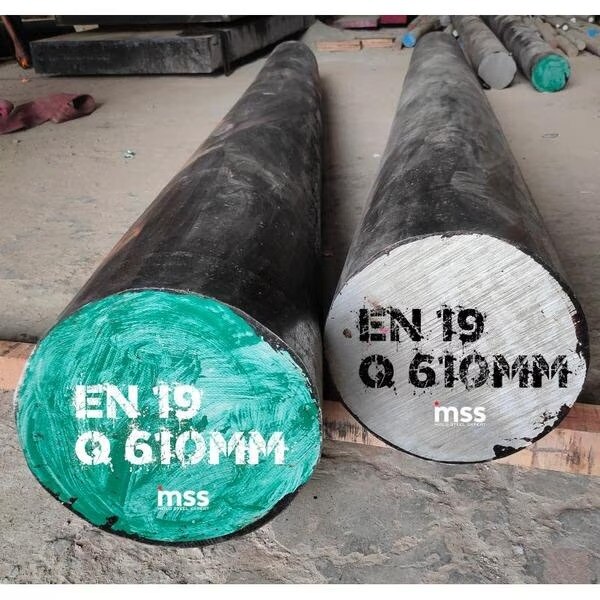
A 610 mm diameter bar is not a 610 mm length: it is a multi-tonne forged section whose weight, core properties, machining time and transport requirements differ sharply from ordinary round stock. By comparing area, mass, starting condition, alternatives and purchasing documents, you can decide whether the size is justified and compare quotations on an equal technical basis.
Key takeaways
- 610 mm refers to diameter, not cut length.
- A 610 mm solid bar weighs about 2,295 kg per metre.
- Compare condition, heat treatment, tolerances, and certification—not diameter alone.
- Require chemistry, mechanical results, dimensions, and traceability on the quotation.
What does 610 mm mean in an EN19 round bar size comparison?
A 610 mm EN19 round bar means a nominal diameter of 610 mm, not a 610 mm cut length. For an EN19 round bar size comparison, cross-sectional area matters because it rises with diameter squared. The solid-bar formula is mass per metre = diameter squared × 0.006165, with diameter in millimetres.
For 610 mm: 610² × 0.006165 = approximately 2,294 kg per metre; its area is about 292,250 mm².
| Size | Cross-sectional area | Theoretical mass per metre |
|---|---|---|
| 50 mm | 1,964 mm² | 15.4 kg |
| 100 mm | 7,854 mm² | 61.7 kg |
| 150 mm | 17,672 mm² | 138.7 kg |
| 200 mm | 31,416 mm² | 246.6 kg |
| 300 mm | 70,686 mm² | 554.9 kg |
| 500 mm | 196,350 mm² | 1,541.3 kg |
| 610 mm | 292,250 mm² | 2,294 kg |
The nominal diameter describes the round section; the cut length determines how much total steel you receive. A 6 m 610mm EN19 steel bar therefore approaches 13.8 tonnes before allowances.
Actual supplied weight changes with length, diameter tolerance, forging allowance, scale, crop loss and machining allowance, so calculate the purchase weight from the quoted dimensions rather than the nominal size alone.
How does a 610 mm bar change handling and machining?
A 610 mm diameter changes the workshop plan before cutting begins: the bar needs verified crane capacity, certified lifting gear, storage supports and floor-loading checks, not just a higher material budget.
- Confirm turning-machine swing, chuck or faceplate diameter, spindle power and steady-rest capacity.
- Check whether the saw can accept the diameter and whether the blade, coolant flow and clamping system suit forged steel.
- Confirm transport weight, dimensions, loading points and any route permit before dispatch.
- Calculate radial machining allowance and removed volume: π × length × (starting diameter² − finished diameter²) ÷ 4. Tonnes purchased alone hide chip volume and disposal cost.
Stock-removal time depends on starting diameter, finished geometry, cutting depth, feed, tooling, machine power, interrupted cuts and whether roughing is staged. Request a rough-machining estimate; installing a larger machine does not automatically solve poor fixturing or inadequate power.
| Starting form | Workshop effect | Planning consequence |
|---|---|---|
| 610 mm solid bar | Maximum lifting weight, chips and rough-turning time | Check crane, floor, chuck, spindle and sawing limits |
| Smaller solid bar | Less stock and easier handling | Use only if the finished section and properties permit |
| Bored or hollow forging | Less metal to remove for rings, flanges and hollow shafts | Specify bore quality, reduction ratio, ultrasonic coverage and forging route |
An EN19 round bar buying guide should compare this total route, not only price per tonne. For an EN19 610 mm round bar for comparison, a hollow preform can reduce lifting weight, machining time and waste, even when its purchase price is higher.
Which starting form and heat-treatment condition should you compare?
An EN19 designation does not make a 610 mm bar technically equivalent to smaller stock. For an EN19 610 mm round bar comparison, match the starting form, delivery condition and test location, not the grade name alone.
| Condition | Effect on purchase and machining |
|---|---|
| Hot-forged/open-die-forged | Refines and directs grain flow; leaves scale and machining allowance; internal quality requires ultrasonic testing. |
| Normalized | Softer and easier to machine than quenched-and-tempered stock; final strength depends on the component heat treatment. |
| Annealed | Lowest hardness and best machinability; requires substantial allowance and later hardening for demanding service. |
| Quenched-and-tempered | Controls final strength and toughness; hardness, core properties and tempering cycle must be stated. |
| Peeled or ground | Improves surface inspection and dimensional accuracy; removes less stock but does not prove core quality. |
| Rough-machined | Provides near-net geometry; verify remaining allowance, distortion and whether the supplied heat treatment remains valid. |
One 610 mm forging is preferable to joining smaller pieces when accuracy and continuity matter. Welds add heat-affected-zone cracking and distortion risk; multiple forgings interrupt grain flow and add setups, alignment checks and machining work.
A 610 mm section cools far more slowly at its centre than a small 4140 bar. State austenitising, quenching, tempering, hardness, minimum centre properties and whether tests come from the centre, quarter-radius or surface. Identify an integral, attached or separately forged test piece.
Specify ultrasonic examination to EN 10228-3 or ASTM A388/A388M, including the acceptance level and report method. Otherwise, a surface result cannot certify the core.
Which EN19 steel round bar alternatives are technically credible?
42CrMo4 or AISI 4140 is the closest mainstream substitute, but neither is automatically equivalent to EN19. Compare chemistry, delivery condition, heat-treatment cycle, hardness, tensile and impact results, and measured core properties before approving the change.
| Alternative | Best technical use | Limits and checks |
|---|---|---|
| 42CrMo4 or AISI 4140 | Similar chromium-molybdenum performance; broad availability and good machinability | Confirm chemical limits, quenched-and-tempered condition, hardenability and 610 mm core properties |
| EN24/817M40 or 34CrNiMo6/AISI 4340 type | Higher hardenability, toughness and strength retention in large sections | Higher alloy cost, more demanding heat treatment and processing; verify impact and centre hardness |
| EN36 | Carburized components needing a hard, wear-resistant surface with a tougher core | Not a direct through-hardened replacement; specify case depth, carbon potential and distortion limits |
| C45 or AISI 1045 | Lower-cost shafts, pins and lightly loaded machined parts | Poorer hardenability leaves a large centre soft after quenching; unsuitable as a like-for-like 610 mm replacement |
For an EN19 round bar size comparison, select the alternative against the component’s actual tensile, impact and toughness requirements, not its label. Check availability, weldability, machinability and total processing cost: a cheaper billet can become expensive after deeper heat treatment, extra machining or rejected core properties.
EN19 steel round bar alternatives also need a welding review. Its carbon and alloy content increase hard heat-affected-zone and hydrogen-cracking risk, so control consumable hydrogen, preheat, interpass temperature and post-weld heat treatment. A 610 mm section adds restraint and heat-flow problems; use a qualified welding procedure.
What must an EN19 610 mm round-bar quotation prove?
“EN19 QT” and “610 mm” do not complete a purchase specification. An EN19 round bar buying guide must make every offer comparable, especially because 610 mm stock is more likely forged than covered by rolled-bar dimensions.
Ask the supplier to state:
- EN 19, 709M40 or proposed equivalent, governing standard, chemical limits and heat number
- Nominal and actual diameter, cut length, finished diameter, dimensional tolerance, straightness and roundness
- Surface condition, machining allowance, forged or rolled route, and required reduction ratio
- Delivery condition, austenitising, quenching and tempering cycle, hardness range, tensile and impact results
- Whether the test piece is integral, attached or separately forged, plus its location: surface, quarter-radius, mid-radius or centre
- Heat-number traceability, EN 10204 certificate type, ultrasonic standard such as EN 10228-3 or ASTM A388/A388M, and acceptance class
- Packaging, lifting points, transport weight and packed dimensions
A supplier such as Milano Special Steel, Plastic Mold Steel Expert can help source a specified 610mm EN19 steel bar and assemble documentation; you remain responsible for matching certificates and the inspection plan to required core properties.
Use this worksheet before comparing totals:
| Cost item | Record separately |
|---|---|
| Material price | Price per bar and per tonne |
| Machining waste | Allowance, crop loss and chips |
| Inspection | Testing, certificate and ultrasonic charges |
| Lifting | Crane, rigging and handling |
| Transport | Weight, dimensions, permits and freight |
Related products
 | EN19 Steel Round Bars EN19 Steel Round Bars 610mm Dia EN19 is a high-strength alloy steel, commonly used in manufacturing high-performance components. View product → |
 | DIN 1.2616 Steel DIN 1.2316 Round Bars 56mm Dia Milano Special Steel: Premier Supplier of DIN 1.2316 Round Bars and Forged Blocks Since its establishment in 1972, Milano Special Steel has been a... View product → |
Frequently asked questions
What does 610 mm mean in an EN19 round bar size comparison?
It means the bar has a nominal 610 mm diameter. It does not describe the bar’s cut length. Use diameter squared to compare cross-sectional area and mass per metre.
How does a 610 mm bar change handling and machining?
The large diameter greatly increases mass, lifting requirements, turning capacity, material removal, cutting time, and workholding demands. Confirm your crane, slings, machine envelope, chuck, steady rest, and tooling capacity before ordering.
Which starting form and heat-treatment condition should you compare?
Compare bars in the same supply condition, such as annealed, normalized, quenched and tempered, or stress relieved. Match hardness, mechanical properties, dimensional tolerance, straightness, machining allowance, and inspection documents.
Which EN19 steel round bar alternatives are technically credible?
Compare alternatives by chemistry, hardenability, section-size performance, heat-treatment response, hardness, toughness, machinability, and applicable material standard. A similar nominal diameter does not make two grades interchangeable.
What must an EN19 610 mm round-bar quotation prove?
Ask for the grade and standard, nominal diameter and length, supply condition, heat-treatment details, chemical analysis, mechanical test results, dimensional tolerances, surface condition, test certificate, heat number, and delivery limits.
Related products
 | DIN 1.2738 Tool Steel DIN 1.2378 Steel Round bars, High-Quality P20 Tool Steel View product → |
DIN 1.2083 ESR STEEL DIN 1.2083 ESR STEEL ROUND BAR 81MM AISI 420 is a martensitic stainless steel with high carbon content, known for its good hardness, corrosion resistance, and wear resistance. View product → |
 | DIN 1.2344 TOOL STEEL BLOCKS, H13 TOOL STEEL DIN 1.2344 TOOL STEEL, H13 TOOL STEEL DIN 1.2344 TOOL STEEL & H13 TOOL STEEL – PROPERTIES, PRICE, APPLICATIONS, DIFFERENCES, ALTERNATIVES & COMPOSITION Introduction to DIN 1.2344 Tool... View product → |
Keywords