A 77 mm plate is worth buying only when its supplied condition, machining allowance, certification and heat-treatment plan match the finished mould requirement. By checking the stock dimensions, traceability, internal quality and total usable cost, you can decide whether ESR steel offers a real advantage over a conventional or alternative mould grade.
Key takeaways
- Confirm whether 77mm means finished thickness or saw-cut oversize.
- Request EN 10204 3.1 certification, heat number and ESR status.
- Price machining, heat treatment, testing, freight and finishing separately.
- Compare corrosion resistance, toughness and machinability against 1.2316 and 1.2343.
What exactly are you receiving when you order 77 mm plate?
“77 mm” is not automatically the finished 77.00 mm dimension. A 77mm DIN 1.2083 ESR plate may be supplied as a finished, milled thickness, or as saw-cut oversize mould steel with machining allowance. Confirm which meaning applies before comparing prices.
A plate near 77 mm can be poor value if both faces require several millimetres of removal. A thinner precision-machined plate may reduce cutting time, distortion risk and usable waste. For a large mould base, a thicker blank can make economic sense when the design already needs substantial machining.
- State finished length and width, or the permitted cutting oversize.
- Specify the 77 mm steel plate thickness tolerance, flatness, parallelism and squareness, with measurement locations.
- Require the face condition: sawn, milled, ground or machined, and identify whether edges are sawn or milled.
- State the minimum order quantity, packing requirement and acceptable replacement time.
- Request the heat number on the plate, certificate and packing list; inspect thickness at several points and both faces for laps or deep grinding marks.
- Name the ultrasonic-testing class or acceptance level, probe direction and report format.
- Compare usable finished kilograms: estimate the final machined dimensions, multiply by steel density, then add cutting, machining, testing, transport and rejection-risk costs. Do not compare nominal plate weight alone.
A purchase order should say “77 mm after machining” or “77 mm supplied with X mm allowance per face,” never just “77 mm plate.”
Which certificate and delivery condition make the plate trustworthy?
A trustworthy quotation must prove more than “1.2083 ESR”: it must identify DIN 1.2083 X42Cr13 under EN ISO 4957, show chemistry, and state the delivery condition. Check carbon, chromium, silicon and manganese on the certificate; an AISI 420 comparison does not make AISI 420 automatic proof of EN 1.2083 compliance.
| Condition | What it means | Evidence to demand |
|---|---|---|
| Annealed | Machinable before hardening | Supplied hardness in HB or HRC, plus heat-treatment status |
| Pre-hardened | Delivered ready for limited machining | Recorded hardness range in HRC or HB |
| Hardened and tempered | Heat-treated for service | Actual hardness, tempering schedule and test location |
Request a heat-numbered mill test certificate mould steel record that matches the plate and packing list. Confirm these items before acceptance:
- Chemical analysis for carbon, chromium, silicon and manganese
- ESR or VAR melting route, not just “ESR” in the quotation
- Ultrasonic test standard, class, probe direction and result
- Inclusion rating and positive material identification
- Heat number repeated on the plate, certificate and packing list
A surface hardness reading cannot confirm the core condition of a 77 mm section. Uneven cooling can leave the centre softer, harder, or dimensionally unstable than the tested face. For production-critical moulds, require representative thick-section hardness results and retain a sample for independent positive material identification.
Without these records, the label describes an intention, not verified grade compliance.
What will 77 mm 1.2083 ESR cost after heat treatment and finishing?
The final cost is the plate price plus annealed-state machining, heat treatment, grinding and polishing, with distortion or rework added if the 77 mm section moves. The ESR premium is worth paying when a mirror-finished or textured cavity makes consistent polishability and toughness important; ESR mainly reduces segregation and non-metallic inclusions.
ESR polishability is not a guarantee of dimensional stability, hardness or longer mould life. Machine the material in its annealed condition, then require the written DIN 1.2083 ESR heat treatment schedule, including austenitising temperature and soak, vacuum-gas, air or oil quench choice, and tempering cycles.
A common working target is 48–54 HRC, but the certificate must state the specified 1.2083 hardness HRC rather than merely “hardened.” A 77 mm section can retain austenite, develop core-to-surface hardness variation, or distort when the core cools more slowly than the surface.
Ask for these records before comparing the ESR premium:
- Hardness readings from representative thick sections, not only the surface
- Measured mould steel dimensional change after hardening and tempering
- The complete heat-treatment curve, quench medium and tempering temperatures
- A sample from the same heat polished to the proposed finish
- Inspection for pinholes, orange peel, streaks, carbides and grinding damage
A polished sample is stronger evidence than the ESR label. If the supplier cannot provide thick-section results and finishing evidence, a cheaper standard plate with verified processing may deliver better usable value.
How does 1.2083 ESR compare with the alternatives?
1.2083 ESR is the sensible choice when corrosion and cavity finish matter more than maximum toughness. Its practical working hardness is about 48–54 HRC, with good polishability and consistent inclusion control from ESR, but machining becomes harder after hardening and weld repair requires controlled preheat, compatible filler and post-weld tempering.
| Grade | Corrosion resistance | Hardness and finish | Machining, toughness, repair and cost |
|---|---|---|---|
| DIN 1.2083 ESR | Good, but not rust-proof | About 48–54 HRC; very good polishability | Moderate machining; moderate toughness; weld repair needs procedure; medium-high cost |
| DIN 1.2316 ESR | Higher chromium resistance than 1.2083 | High hardness potential; excellent polished-cavity performance | More difficult machining; better corrosion-focused choice; repair is demanding; high cost |
| DIN 1.2085 | Moderate stainless protection | Good polishability; hardness depends on supply condition | Easier machining than hardened 1.2083; toughness and corrosion performance are lower; lower cost |
| AISI 420 | Comparable family, not automatic EN compliance | Good polishability and hardening response | Similar machining and repair limits; confirm chemistry and condition; cost varies |
| DIN 1.2311 | Low corrosion resistance | Usually supplied pre-hardened; acceptable finish | Easy machining, better general toughness and weld repair; lower cost |
Choose a stainless grade for corrosive plastics, condensation, cleaning chemicals or polished cavities. Choose DIN 1.2311 when corrosion is irrelevant and the DIN 1.2311 comparison favours machining and price.
Do not choose 1.2083 for high-impact tooling, heavily loaded inserts, hot-work service or unusually deep sections. Examine tougher grades when impact, chipping, cracking or severe thermal cycling dominates. Gurugram’s humidity and monsoon air still demand dry storage, clean handling and chloride protection.
How should you compare Gurugram suppliers before placing the order?
Compare each quote by usable finished cost, not by the 77 mm plate’s invoice price. Your ESR plate price comparison should include:
| Option | Advantage | Main risk |
|---|---|---|
| Local steel supplier in Gurugram | Lower cutting charges, shorter delivery and faster replacement | Weaker traceability if documents are incomplete |
| Imported stockist | Wider availability and established paperwork | Freight, customs delay and replacement lead time |
| Mill-direct ESR plate | Strongest heat and melting-route traceability | Higher minimum order quantity and less flexible cutting |
Use this landed-cost formula: usable finished weight × quoted rate, plus cutting, machining allowance, heat treatment, ultrasonic testing, transport, minimum-order charges and an allowance for rejection or replacement risk. Divide the total by usable finished kilograms, not nominal weight.
A nearby supplier can win even at a higher kilogram rate when a rejected plate would stop production for weeks; mill-direct wins when traceability outweighs quantity and lead-time costs.
Ask Milano Special Steel, Plastic Mold Steel Expert for the dimensions, heat-numbered certificate, packing list and UT report, then verify them independently. Make this your mould steel procurement checklist:
- Match the heat number on the plate, certificate and packing list.
- Measure thickness at multiple locations.
- Inspect both faces for laps and deep grinding marks.
- Review the ultrasonic testing steel plate report, including class, probe direction and acceptance level.
- Retain a sample for positive material identification.
Buy 77 mm only when its verified usable cost and quality beat a thinner precision-machined plate or lower-cost grade for the mould’s actual duty.
Related product
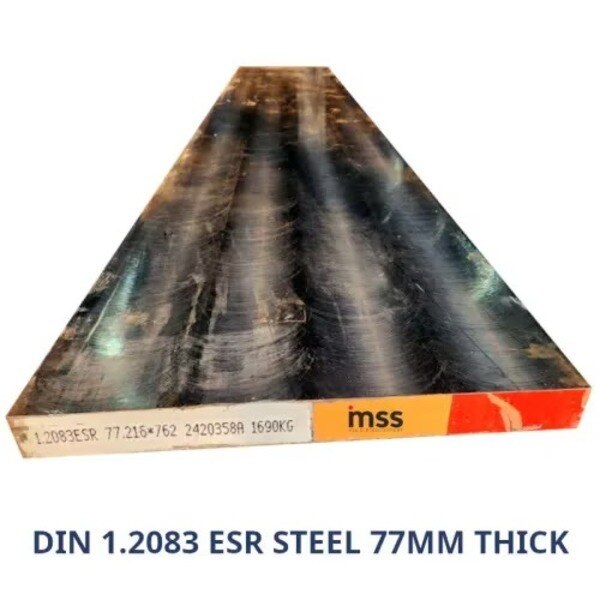
 | DIN 1.2083 ESR STEEL DIN 1.2083 ESR Steel Plate 77mm thickness DIN 1.2083 ESR (Electro-Slag Remelted) is a high-quality stainless tool steel known for its excellent corrosion resistance, high hardness, and wear... View product → |
Frequently asked questions
What exactly do you receive when ordering 77mm plate?
Confirm whether the supplier offers a finished 77.00mm milled plate or saw-cut 1.2083 ESR plate with machining allowance.
Which certificate and delivery condition make the plate trustworthy?
Request an EN 10204 3.1 inspection certificate showing the heat number, chemical analysis, mechanical properties and delivery condition.
What does 77mm 1.2083 ESR cost after heat treatment and finishing?
Compare the steel price with separate charges for machining allowance removal, heat treatment, surface finishing, inspection, packing and freight.
How does 1.2083 ESR compare with alternative mould steels?
Compare 1.2083 ESR with 1.2316 and 1.2343 for corrosion resistance, toughness, polishability, hardness and machining requirements.
How should you compare Gurugram suppliers before ordering?
Compare exact dimensions, tolerances, certificate details, delivery condition, lead time, finishing scope, replacement terms and delivered cost.