Toolmakers near Gurugram need steel that reaches milling, drilling, mould assembly, and production trials without an avoidable heat-treatment detour. By the end, you will be able to distinguish standard P20 from P20 High Hard and DIN 1.2738, specify the right stock, inspect its documents, and identify when another mould or tool steel is the safer choice.
Key takeaways
- Use pre-hardened P20 for mould bases, cores, cavities, and die components.
- Match supplied hardness to your machining, grinding, and polishing process.
- Specify finished dimensions, machining allowance, flatness, and inspection documents.
- Choose another steel when wear, corrosion, or high-temperature strength dominates.
Why pre-hardened P20 fits NCR tooling work
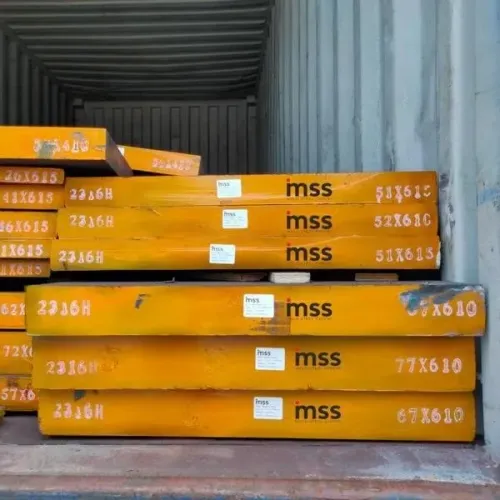
Pre-hardened P20 steel plates suit injection mould bases, cores, cavities, and die components serving NCR’s automotive, appliance, electronics, and plastics manufacturers. They move directly to local sawing, milling, drilling, grinding, and assembly without sending the job to a separate hardening vendor.
That advantage disappears if your machine shop cannot control movement and flatness in 28–34 HRC stock.
| Option | What it means | When it applies |
|---|---|---|
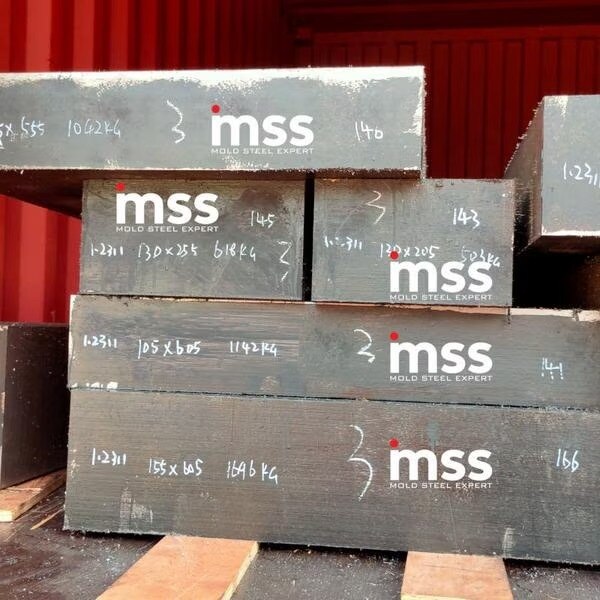
| DIN 1.2311 | Standard P20, usually supplied around 28–33 HRC | General mould bases, housings, moderate-use cavities, and machined die components |
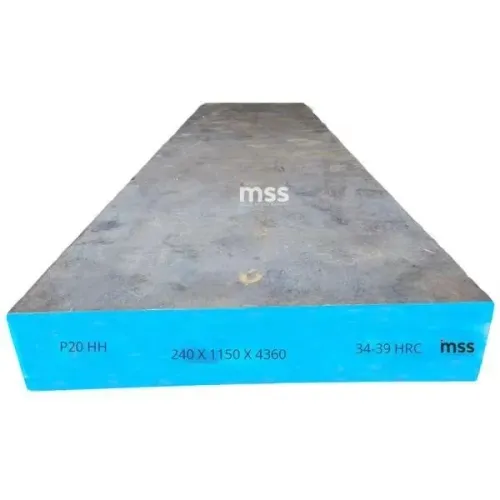
| P20 High Hard | Higher supplied hardness, commonly 40–44 HRC | Smaller wear-prone inserts or components needing extra service life without another hardening cycle |
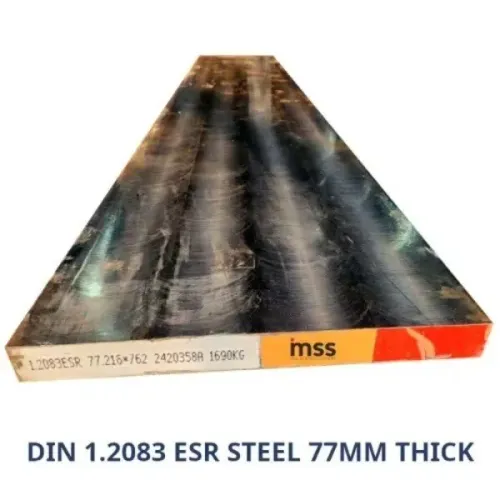
| DIN 1.2738 | Nickel-alloyed P20-type steel with better through-hardening in large sections | Large mould blocks and thick plates where the centre must retain consistent hardness |
Choose DIN 1.2311 for ordinary mould work and extensive conventional machining. Select P20 High Hard when wear justifies slower cutting and more demanding drilling; it is not a substitute for H13 in sustained hot service or for high-wear glass-filled polymers. Choose DIN 1.2738 for large sections, not simply because its label sounds stronger.
Specify the exact grade, delivery hardness, chemistry or mill designation, and inspection documents; “P20” alone is incomplete. Protect machined faces and edges from humid NCR storage, and validate polishability for optical surfaces rather than assuming every P20 plate will produce a mirror finish.
How supplied hardness changes machining and finishing
At roughly 28–34 HRC, pre-hardened P20 lets you machine the mould without a separate quench-and-temper cycle. P20 machinability remains practical for local workshops, but cutting forces, tool wear and residual movement are higher than with annealed steel.
- Milling P20: use rigid fixturing, carbide cutters and controlled engagement; aggressive roughing can release stress and move a thin wall.
- Drilling: use short, rigid carbide or coated drills, peck cycles and coolant. A blunt drill can wander, harden the hole wall and damage the exit.
- Tapping: reduce speed, use suitable coated taps and clear chips frequently. Broken taps are difficult to remove from 30 HRC stock.
- EDM P20 steel: leave allowance for the recast layer, then remove damaged material by polishing or light grinding. Excessive energy can deepen the heat-affected zone.
- Polishing: pre-hardness supports stable edges, but EDM damage, vibration marks and cutter lines remain visible until fully removed.
- Texturing: specify the texture after confirming the surface finish; uneven polishing or residual EDM damage will print through the pattern.
For thick plates, rough-machine, stress-relieve at the steel producer’s specified cycle, then finish-machine. Welding needs controlled preheat, interpass temperature, low-hydrogen practice, compatible filler and slow cooling; welding onto cold P20 can leave a cracked or excessively hard heat-affected zone that becomes obvious after polishing.
How to specify plate size for moulds and die components
Specify the finished component first, then work backward to the P20 plate thickness. Add machining stock for every face that will be milled or ground, not just the visible mould surface; otherwise roughing can expose defects or leave too little material for correction.
1. For mould base steel, order a plate whose length and width cover the complete base, clamping margins, dowel features and saw-cut loss. Add extra thickness for parallel grinding and leave enough stock to remove rolled-surface damage.
2. For a cavity insert or core insert steel, calculate the finished block around the parting line, shut-off faces, cooling channels and ejector features. Keep separate allowance for rough milling, finish milling and polishing; a typical allowance is a machining decision, not a fixed P20 rule.
3. For die shoes and die components, specify thickness, length, width, squareness and flatness against the assembly drawing. A thick plate that is not flat can distort clamping, alter die clearance and force rework during fitting.
4. For a wear insert, confirm whether the insert will be nitrided. Reserve the grinding or polishing stock needed after nitriding, and specify the required compound-layer and diffusion-zone treatment before cutting material.
5. Rough-machine heavy sections, then measure movement and stress-relieve before finish machining. Prehardened P20 avoids quench distortion, but residual stress can still move a plate after stock removal; record flatness again before final fitting.
What to require before accepting a P20 plate
Accept the plate only when its paperwork, traceability, hardness map, and internal-quality report agree. “P20” alone is insufficient because 1.2311, sulfur-modified 1.2312, and nickel-alloyed 1.2738 are different grades.
- Request a P20 mill test certificate showing the exact standard or mill grade, heat number, chemical analysis, delivery hardness, test method, and plate dimensions. Check carbon, chromium, manganese, molybdenum, nickel, and sulfur against the ordered specification.
- Match the heat number on the certificate to the stamp, tag, or stencil on the plate. Reject an untraceable plate.
- Require the producer’s ultrasonic testing P20 report, including the test standard, scanning direction, acceptance class, and any recorded indications. A certificate without a UT result does not prove internal soundness.
- Measure thickness, length, width, flatness, squareness, and machining allowance. Inspect rolled faces and edges for seams, laps, cracks, dents, and flame-cut damage.
- Take hardness readings on a grid across both faces and near the centre and edges, using the agreed HRC or HB method. A consistent result within the specified delivery range—commonly about 28–34 HRC or 280–330 HB—supports a through-hardened steel section; one surface reading does not.
Evidence | What it confirms | What it cannot confirm P20 mill test certificate | Grade, chemistry, heat and delivery condition | Actual plate identity without matching heat number Hardness map | Uniform hardness through accessible locations | Hidden laminations UT report | Internal continuity and absence of unacceptable laminations | Correct chemistry or hardness Milano Special Steel, Plastic Mold Steel Expert can supply the certificate, heat traceability, UT report, and hardness map as one acceptance file; ask for all four before cutting the plate.
Related products
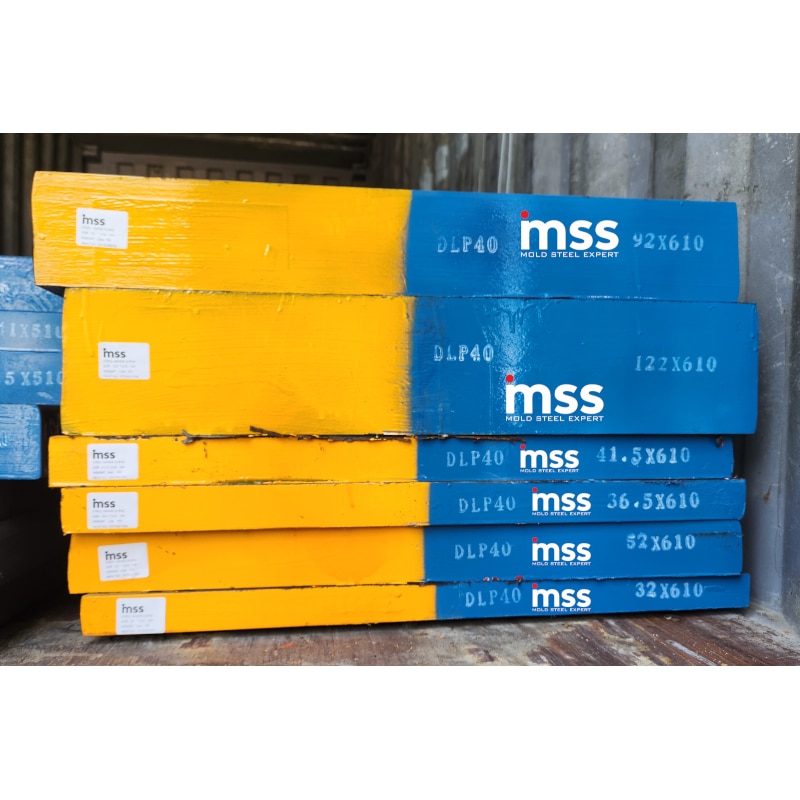 | P20 HIGH HARD STEEL 40 HRC to 44 HRC P20 High Hard steel 40 HRC to 44 HRC Yes! Milano Special Steel is a leading supplier of P20 High Hard Steel across Delhi, Gurugram, Manesar, Dharuhera, Noida, Jaipur, Faridabad, Punjab,... View product → |
 | P20 HIGH HARD STEEL P20 High Hard Steel is a popular grade of tool steel that is commonly used in the manufacturing of molds, dies, and other high-performance components... View product → |
When P20 is the wrong choice for a tool
Move away from P20 when the tool’s size, surface finish, wear load, or heat exposure exceeds its design range. P20 suits ordinary mould surfaces and moderate production, but its prehardness does not provide the wear resistance of H13, D2, or powder-metallurgy steel.
P20 vs 1.2738 is mainly a section-size decision. Nickel-alloyed 1.2738 is intended for large mould blocks where a standard P20 section could develop hardness variation, internal movement, or uneven response through the thickness. Specify 1.2738 when the mould is large enough that through-hardness and dimensional stability matter more than the lowest machining effort.
P20 vs NAK80 is a surface-quality decision. Choose NAK80 for high-gloss optical parts, demanding textures, or moulds where EDM, polishing, and appearance defects carry a high rejection cost. P20 offers useful polishability, but it is not automatically a polished mould steel: inclusions, segregation, sulfur, or weld repairs can limit the finish.
Request cleanliness data and validate a sample.
- Choose H13 for sustained hot-work service, such as die-casting tooling.
- Choose D2 or powder steel for severe abrasive wear, including highly glass-filled polymers.
- Choose annealed tool steel when extensive metal removal, complex machining, or planned post-machining heat treatment justifies sending the part to a hardening vendor.
Protect P20 faces, holes, and edges from moisture during humid NCR transport; it has ordinary tool-steel corrosion resistance, not stainless-steel protection.
Frequently asked questions
Why does pre-hardened P20 suit tooling work near Gurugram?
It moves from supplied plate to sawing, milling, drilling, grinding, and assembly without a separate hardening step, supporting NCR mould and die production.
How does P20 hardness affect machining and finishing?
Higher supplied hardness increases cutting and grinding demands, so confirm the hardness range before selecting tools, feeds, finishing methods, and machining allowances.
What information should you provide when specifying a P20 plate?
Give the required length, width, thickness, finished dimensions, machining allowance, flatness needs, and whether the plate will become a mould base, core, cavity, or die component.
When is P20 the wrong choice for a tool?
Select another grade when the tool needs stronger wear resistance, corrosion resistance, or high-temperature performance than P20 provides.
Related products
 | P20 STEEL/ DIN 1.2311 P20 STEEL PLATES is a widely used tool steel known for its high toughness, wear resistance, and machinability. View product → |
 | P20 STEEL/ DIN 1.2311 P20 STEEL DIN 1.2311 Grade P20 Steel Supplier in India - Milano Special Steel Introduction Milano Special Steel is a leading supplier of high-quality DIN... View product → |
 | DIN 1.2738 Tool Steel DIN 1.2738 Steel, P20 Steel Plates DIN 1.2738 Steel: Plastic Mould Steel Supplier in India. What is DIN 1.2738 Steel? DIN 1.2738 steel is a pre-hardened plastic mould steel with nickel... View product → |
 | DIN 1.2738 Steel, P20 Tool Steel DIN 1.2738 Steel and P20 Tool Steel Rounds Leading DIN 1.2738 Steel and P20 Tool Steel Rounds, DIN 1.2738 (P20HH) Steel Supplier in India: Premium Quality Plates & Rounds for Diverse... View product → |