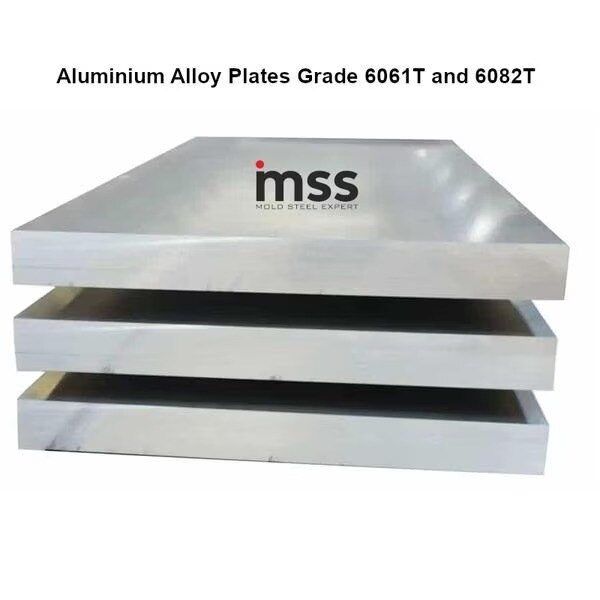
Choosing an 80 mm aluminium plate for a mould requires more than comparing weight or price with tool steel. You need to verify the alloy temper, certificate, dimensional stability, machining route, thermal behaviour and wear protection before deciding whether 6082 is suitable for the specific mould component.
Key takeaways
- Specify EN AW-6082, T6 or T651, and EN 485-2 on every quotation.
- Use 6082 for lighter mould bases, prototypes, inserts, and low-wear tooling.
- Match 80 mm plate thickness to load, machining allowance, and finished geometry.
- Control heat, clamping, support, and stock removal to preserve flatness.
What 6082T means on a mould-plate quotation
“6082T” is incomplete for procurement. For a 6082T aluminum plate for mould making in Gurugram, state EN AW-6082, the defined temper, usually T6 or T651, and the governing product standard, such as EN 485-2.
| Temper | Meaning | Buying implication |
|---|---|---|
| T6 | Precipitation-hardened condition | Suitable when stress relief is not specified |
| T651 | T6 material stress-relieved by controlled stretching | Safer for a large, heavily pocketed plate because residual stress can cause less movement during machining |
Published 6082-T6 plate values are commonly about 290–340 MPa tensile strength and 240–310 MPa yield strength, depending on thickness and product form. An 80 mm plate needs thickness-specific values on the material test certificate, not a generic datasheet.
Aluminium density is near 2.70 g/cm³, elastic modulus near 69 GPa, and thermal expansion about 23–24 × 10⁻⁶/K.
Your enquiry should request:
- Chemical composition and heat or batch number
- Temper, dimensions, cut size and 80 mm thickness tolerance
- Flatness, squareness, surface condition and saw-cut allowance
- EN 485-2 compliance and EN 10204 type 3.1 certification when traceability is required
Also confirm whether the stock is wrought 6082 or cast tooling plate; their residual stress and machining behaviour are not interchangeable.
Where lightweight 6082 mould tooling earns its advantage
A same-volume 6082 aluminium plate weighs roughly one-third as much as P20, 1.2738, 1.2083 or 1.2316 steel. That cuts crane load, mould installation effort, machine setup time and manual-handling risk.
The saving comes with lower stiffness and strength. Aluminium’s elastic modulus is about 69 GPa, compared with roughly 200 GPa for steel, so a 6082 mould needs adequate backing support and direct load paths to limit deflection under clamping and injection pressure.
For 6082t aluminum plate mould applications in Gurugram, choose the material when low mass and fast machining outweigh maximum wear life:
- Prototype, short-run and moderate-pressure moulding, where quick machining and easier installation reduce turnaround time.
- High-volume, abrasive or high-pressure production, where steel remains the safer choice; use steel wear inserts if an aluminium body is retained.
- Designs with cooling channels placed to control hot spots, because 6082 conducts heat at about 170 W/m·K versus roughly 20–30 W/m·K for conventional mould steels. Better heat spreading can shorten trials, but channel location still controls temperature uniformity and cycle time.
Include aluminium’s thermal expansion, approximately 23–24 × 10⁻⁶/K, in clearances, datums and alignment calculations. Inspect the mould at its operating temperature, not only at room temperature, or thermal movement can appear as a fit or flash problem during production.
How to match an 80 mm plate to the mould component
An 80 mm plate suits a mould base, backing plate, prototype cavity, core, fixture or electrode holder when support is adequate and service loads remain moderate. An 80mm aluminum alloy plate mould maker should match the plate to the component, not assume that thickness alone provides steel-like performance.
1. Assess the working conditions before choosing 6082. Check clamping and injection load, contact pressure, required surface finish, expected shot count, resin abrasiveness, mould temperature and frequency of sliding contact. Lower aluminium hardness increases scratching, galling and wear when contact is repeated.
2. Use 6082 for a supported lightweight base, core, prototype cavity, fixture or electrode holder. Do not leave an unprotected shut-off, slide track, lifter contact area, ejector-bushing seat or frequently rubbed parting-line surface in aluminium when repeated cycles demand wear resistance.
3. Machine and polish cavity surfaces to a good finish, but do not confuse polish quality with steel-like wear life. Trial textured surfaces against the specified texture depth and release requirement. Treat 6082t plate plastic mould components with hard anodising, nickel plating or another specified finish only after confirming the treatment’s limits.
4. Fit steel inserts in leader-pin bores, ejector seats, shut-offs and high-wear edges. Treatment improves surface performance; it does not restore steel’s bulk stiffness or strength.
5. Prefer dowelled or bolted construction where alignment matters. Welding softens the T6/T651 heat-affected zone and can distort the assembly, so welded designs require allowance for reduced local strength and post-weld machining.
How to machine 80 mm 6082 without losing flatness
An 80 mm 6082 plate is stock thickness, not proof that the finished mould will remain accurate. Before ordering, ask for the saw-cut allowance, as-supplied flatness, thickness tolerance, surface condition and confirmation that the plate is stress-relieved. Sawing can leave burrs and local distortion even when mill-supplied flatness is acceptable.
Use this machining sequence:
- Rough-machine both faces symmetrically, removing similar amounts from each side.
- Leave a controlled finishing allowance, then let the plate relax before final machining.
- Establish datums after roughing and measure flatness and twist between operations.
- Finish datum faces, pockets and mould features, including critical bores and shut-offs, in the final setup.
A deep pocket cut from one face can release rolling or heat-treatment stress, producing bow or twist.
| Plate type | Machining behaviour | Quotation point |
|---|---|---|
| Wrought 6082-T6/T651 | Residual stress can cause movement after heavy pocketing | State temper, allowance and stress-relief condition |
| MIC-6 or cast tooling plate | Often machines more uniformly across a large section | Confirm cast grade, thickness and flatness separately |
| Steel tooling plate | Higher stiffness but greater mass and machining load | Compare against the mould’s wear and load requirements |
Clamp only on supported areas; excessive force can distort the plate. Use sharp, polished aluminium-cutting tools with suitable rake geometry, coolant or directed air, and effective chip evacuation. Recut chips can scratch the surface and generate heat.
Compare CNC time, scrap, handling and finishing cost—not only delivered price per kilogram—because a cheaper plate can cost more after distortion and rework.
What to include in a Gurugram supplier comparison
Send the finished part drawing or mould requirement to an aluminum mould tooling plate supplier in Gurugram, not merely “6082T plate.” For 6082T aluminum plate for mould making in Gurugram, specify:
- Plate length, width and 80 mm nominal thickness; EN AW-6082; T6 or T651 temper; and EN 485-2 compliance.
- Required cut size, machining allowance, flatness after cutting, squareness and surface condition.
- Heat traceability and an EN 10204 type 3.1 certificate. Request the actual certificate, not a generic web datasheet.
Ask the supplier to identify the stock form before comparing prices.
| Option | What to verify | Why it matters |
|---|---|---|
| Wrought 6082 | T6 or T651, thickness and stress-relief status | Residual stress can affect bow, twist and machining movement |
| Cast tooling plate | Grade, cast condition and flatness certificate | Machining behaviour and stability differ from wrought plate |
| Hybrid assembly | Each material, joint and alignment method | Mixed stiffness can change distortion and service performance |
Confirm how the plate is protected during sawing, lifting and transport. Compare total cost by adding machining hours, pocket material removed, crane or handling requirements, wear inserts, surface treatment and rejected-part risk. Milano Special Steel, Plastic Mold Steel Expert can align dimensions, temper, certification and allowance with the mould design.
Choose 6082 where low mass and rapid machining outweigh wear and stiffness demands; reinforce or change material when they do not.
Related product
 | 6082T Aluminum Alloy Plate 6082T Aluminum Alloy Plate 80mm Aluminium Alloys Plates 6082T: Premium Quality for Plastic Mould, Aerospace & Auto Parts | Best Price in India from Top Suppliers Introduction to... View product → |
Frequently asked questions
What does 6082T mean on an aluminum mould-plate quotation?
Ask the supplier to state EN AW-6082, the exact temper such as T6 or T651, and the governing standard, such as EN 485-2. “T” alone does not identify the material condition.
Where does 6082 aluminum provide an advantage in mould tooling?
Its lower weight helps with mould bases, prototype tools, inserts, and components that do not need steel’s wear resistance or high-temperature strength.
How do you match an 80 mm 6082 plate to a mould component?
Check the component’s finished thickness, machining allowance, clamping loads, support span, cooling channels, and required stiffness before ordering an 80 mm plate.
How can you machine 80 mm 6082 without losing flatness?
Support the plate across its working area, remove stock in balanced passes, control cutting heat, allow the plate to rest between operations, and finish both faces progressively.
What should you compare when choosing a Gurugram aluminum mould-tooling supplier?
Compare the stated alloy and temper, EN 485-2 compliance, thickness tolerance, flatness data, inspection records, cutting allowance, traceability, delivery terms, and machining support.
Keywords