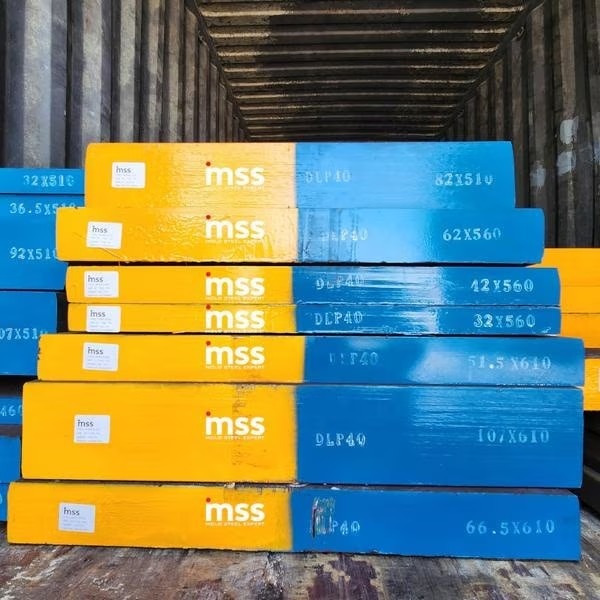
A 40 to 44 HRC specification points to a different tooling decision than ordinary pre-hardened P20 near 30 to 34 HRC. You will be able to match the hardness to mould components, compare competing grades, verify the supplied material, and plan machining and finishing without treating every application as a plastic mould.
Key takeaways
- Use 40–44 HRC P20 for wear-prone inserts, slides, thin edges, and mould surfaces.
- Choose softer P20 when extensive machining, welding, or dimensional correction remains.
- Select H13, S7, or stainless mould steel when heat, impact, or corrosion dominates.
- Verify hardness range, heat-treatment records, dimensions, and test location before acceptance.
Which Gurugram mould components use P20 High Hard at 40 to 44 HRC?
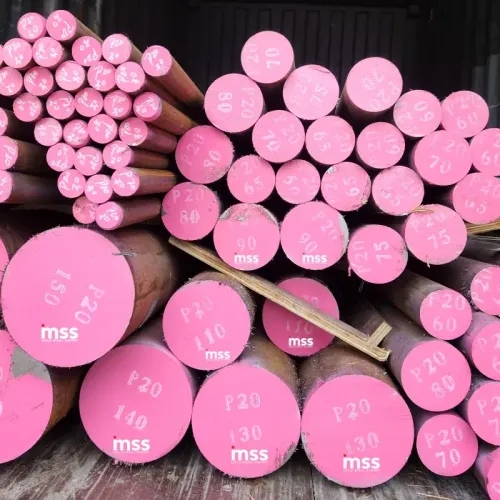
P20 high hard steel 40–44 HRC for applications in Gurugram fits mould surfaces where abrasive resin, thin edges, or sliding contact threatens wear.
Automotive moulds use it for cavities and cores producing PC/ABS bezels, grilles, interior trim, lighting components, and under-bonnet parts; packaging tools use it for closures, while appliance and consumer-product tools use it for housings. It also suits polyamide, PBT, POM, and filled engineering plastics after checking filler type and loading.
| Component | Where 40–44 HRC helps | Selection boundary |
|---|---|---|
| Cavity blocks and cores | Polishable, dimensionally stable surfaces exposed to engineering plastics | Verify steel cleanliness and finish requirements |
| Replaceable inserts, slides, lifters, wear plates | Edge retention, shut-off accuracy, resistance to cavity wear | Useful where repair or replacement is planned |
| Mould bases | Guide pillars, clamping faces, and sliding zones that wear | Do not harden the entire base without a wear reason |
| Compression moulds and selected extrusion tooling | Repeated pressure, abrasion, and profile-contact wear | Check load, temperature, and resin chemistry |
| Low-to-moderate-load forming dies and die components | Better service life than softer pre-hardened P20 | Not a universal hot-work die steel |
P20 high hard steel uses therefore depend on the component, not the product label. For PVC, corrosive flame-retardant compounds, sustained hot service, or die casting, consider 1.2083/420 stainless or H13 instead; hardness alone does not provide corrosion resistance or hot-work performance.
Why choose 40 to 44 HRC for one component instead of softer P20?
Choose 40 to 44 HRC only where wear and edge stability justify harder machining. Ordinary pre-hardened P20 or DIN 1.2311 at about 28 to 34 HRC cuts faster; P20 steel 40 HRC to 44 HRC better resists abrasive glass-filled or mineral-filled resin.
| Component | Reason for choosing 40–44 HRC | Trade-off |
|---|---|---|
| Thin shut-offs, slides, lifter noses | Lower deformation risk and longer edge retention | Interrupted cuts can chip carbide edges |
| Deep ribs and replaceable inserts | Holds narrow edges against abrasive flow and repeated repairs | Drilling, tapping, and reaming become harder |
| Cavity or core wear zones | Finish-machining in supplied condition can avoid post-hardening distortion | Milling is slower and carbide tools wear faster |
Hardness alone does not guarantee a mirror finish. Check steel cleanliness, sulphur content, segregation, remelting route such as ESR or VAR, and heat-treatment history; a free-machining, sulphur-modified variant can cut easily yet polish poorly.
Corrosion changes the decision. PVC and flame-retardant compounds can attack conventional P20, while humid storage and cooling water create rust risk. Select 1.2083 or 420 stainless mould steel when corrosion resistance and surface integrity matter more than the easier machining of P20.
When should you select another steel instead of P20 High Hard?
Select another grade when the mould’s dominant demand is machinability, heat resistance, corrosion resistance, extreme wear resistance, or mirror-finish certainty rather than balanced performance at 40 to 44 HRC.
| Option | Choose it instead when | Main reason |
|---|---|---|
| Standard P20 or DIN 1.2311 | Rough machining, deep pockets, or low wear demand easier cutting | Lower hardness reduces tool wear, drilling effort, and machining time |
| DIN 1.2738 | A large block needs dependable section performance | Nickel-alloyed toughness supports thick sections |
| NAK80 | High polish, texturing, or EDM performance leads the specification | It targets demanding cosmetic mould surfaces |
| H13 | Sustained heat, thermal cycling, or die-casting dominates | Hot-work strength and thermal-fatigue resistance matter more |
| D2 | Severe abrasive wear outweighs toughness and polishability | Higher wear resistance suits aggressive cold-work service |
| Hardened alloy tool steel | Higher hardness or exceptional dimensional stability is required | P20 High Hard may not hold the design’s limits |
P20 high hard steel uses remain strongest in plastic mould tooling and selected low-to-moderate-load forming or bending dies. It is not a substitute for hot-work steel in severe hot service, for 1.2083 or 420 stainless in aggressive corrosion, or for validated optical steel in mirror-finish work.
Before approving it for glass-filled resin, PVC, medical moulds, or transparent parts, check:
- Resin chemistry and filler loading against corrosion and wear risk.
- Steel cleanliness, sulphur level, segregation, remelting route, and achievable surface finish.
- Cooling-water exposure, sterilisation conditions, polish grade, and dimensional tolerance.
Without those checks, high hard steel for tool dies can produce corrosion, poor polish, chipped edges, or unacceptable transparent-part defects.
What should you specify and verify when buying P20 High Hard in Gurugram?
“P20 High Hard” is incomplete as a purchase description. Tell the P20 high hard supplier in Gurugram the steelmaker grade or approved equivalent, thickness, plate or block dimensions, cut size, machining allowance, surface condition, flatness, parallelism, and required inspection standard.
- Require 40 to 44 HRC at delivery, with a stated tolerance and test method, such as Rockwell C under ASTM E18 or EN ISO 6508-1.
- Request the heat number, chemical certificate, and EN 10204 3.1 material-test certificate.
- Specify hardness readings at marked locations across deep ribs, thin cores, and thick blocks. A surface reading does not prove through-hardness uniformity.
- Require ultrasonic inspection for thick blocks, using an agreed standard such as EN 10160 for plates or EN 10228-3 for forgings.
- State that ordinary DIN 1.2311 at roughly 30 HRC under a generic P20 label is unacceptable.
Local stock and cut-to-size supply involve different risks:
| Option | What to compare | Why it matters |
|---|---|---|
| Local stock | Immediate availability, dimensions, transport | Useful for urgent work in Manesar, Bawal, Bhiwadi, Faridabad, or Noida |
| Cut-to-size | Lead time, allowance, saw quality | Reduces machining but delays production |
| Either route | Replacement policy and extra-inspection cost | Protects you against failed hardness or UT results |
Milano Special Steel, Plastic Mold Steel Expert is one Gurugram sourcing option; your specification and test documents remain the protection. This approach also suits requests for p20 high hard steel 40 44 hrc for applications in gurugram.
Related products
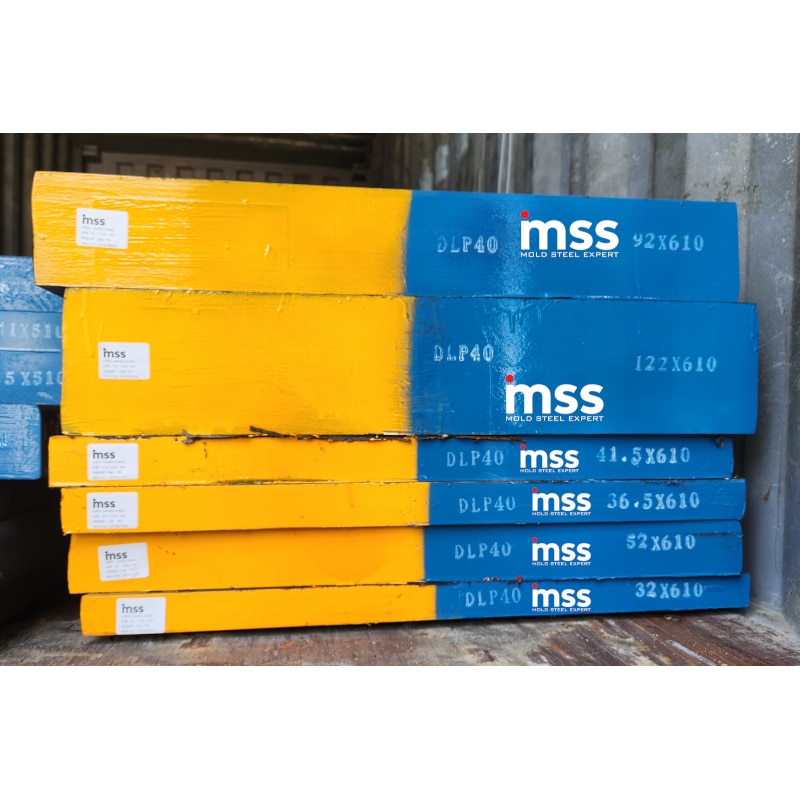 | P20 HIGH HARD STEEL 40 HRC to 44 HRC P20 High Hard steel 40 HRC to 44 HRC Yes! Milano Special Steel is a leading supplier of P20 High Hard Steel across Delhi, Gurugram, Manesar, Dharuhera, Noida, Jaipur, Faridabad, Punjab,... View product → |
 | P20 HIGH HARD STEEL 40 HRC to 44 HRC P20 High-Hard Steel Plates 40 HRC to 44 HRC 25MnCrNiMoV6-6-4, NIMAX, NAK80, P21 Improved View product → |
How do you machine, finish, and measure a 40 to 44 HRC tool?
A 40 to 44 HRC tool can usually be finish-machined in its supplied hardened condition, avoiding post-hardening distortion. Clamp it rigidly, use carbide cutters, short overhangs, controlled feeds and speeds, and continuous chip evacuation. Leave a planned roughing allowance, then stress-relieve when heavy stock removal, thin sections, or asymmetric shapes create distortion risk.
- Rough mill cavities, cores, ribs, and pockets with stable engagement; avoid aggressive interrupted cuts that chip carbide edges.
- Finish mill accessible surfaces, but use grinding or EDM for small radii, deep narrow ribs, hardened shut-offs, and edges that would damage cutting tools.
- Skim or polish away EDM recast layers on highly polished or fatigue-sensitive surfaces; leaving the white layer can promote cracking, staining, and chipping.
- Polish or texture only after confirming the allowance. Nitriding and chrome plating require dimensional checks because both alter surface condition and size.
| Method | Best fit | Main control |
|---|---|---|
| Finish milling | Accessible cavity and core surfaces | Carbide tool life and chip evacuation |
| Grinding | Shut-offs, small radii, precision flats | Avoid thermal damage |
| EDM | Deep ribs and narrow hardened features | Remove or skim recast material |
Typical P20 high hard steel uses demand wear resistance, but P20 steel 40 HRC to 44 HRC is not stainless. Protect it with oil, dry storage, prompt condensation removal, and controlled cooling after polishing. For PVC, medical moulds, or humid service, assess corrosion-resistant steel instead.
Track flash, cavity wear, cycle count, polish quality, dimensional drift, and repair frequency to compare actual service performance.
Frequently asked questions
Which Gurugram mould components use P20 High Hard at 40 to 44 HRC?
Use it for injection-mould inserts, slide faces, lifters, thin ribs, shut-off edges, and cavity areas exposed to abrasive resin or sliding contact.
Why choose 40 to 44 HRC instead of softer P20?
The higher hardness improves resistance to wear, edge deformation, and galling, while retaining more machinability than many higher-hardness tool steels.
When should you select another steel instead of P20 High Hard?
Choose another grade when the mould faces severe heat, repeated impact, corrosive resin, high polishing demands, or wear beyond P20 High Hard's capability.
What should you specify and verify when buying P20 High Hard in Gurugram?
Specify the grade, delivery hardness of 40–44 HRC, dimensions, flatness, ultrasonic quality requirements, test standard, heat-treatment records, and material traceability.
How do you machine, finish, and measure a 40 to 44 HRC tool?
Use rigid carbide tooling, controlled cutting parameters, light finishing passes, suitable coolant, and verify hardness, dimensions, surface finish, and distortion after machining.
Related products
 | DIN 1.2738 Tool Steel DIN 1.2738 Steel, P20 Steel Plates DIN 1.2738 Steel: Plastic Mould Steel Supplier in India. What is DIN 1.2738 Steel? DIN 1.2738 steel is a pre-hardened plastic mould steel with nickel... View product → |
 | P20 STEEL/ DIN 1.2311 P20 STEEL DIN 1.2311 Plastic Mould Steel Plates DIN 1.2311 Plastic Mould Steel Milano Special Steel, located in Gurugram, Haryana, near Manesar, Bawal, and Bhiwadi, is a renowned supplier of... View product → |
Keywords