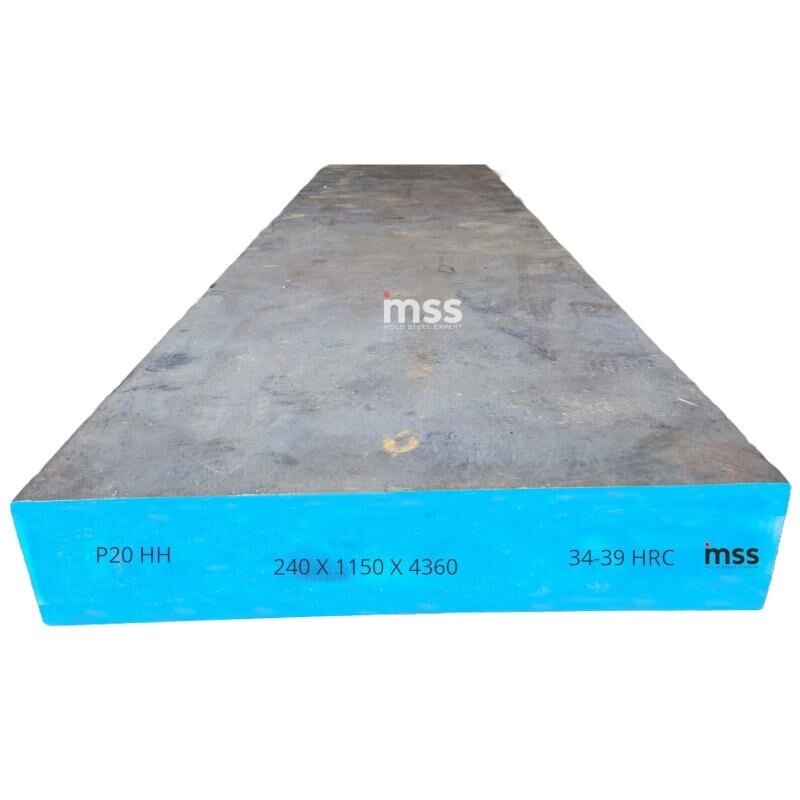
P20 High Hard steel plate is used for mould plates, cavity and core blocks, inserts, supports, and wear-contact parts that need more hardness than conventional pre-hardened P20 without a separate full-hardening operation. By the end, you will be able to match 40 HRC or 44 HRC material to the machining method, mould duty, inspection evidence, and maintenance demands.
Key takeaways
- P20 high hard plate is commonly supplied at 40 HRC or 44 HRC.
- Use it for moulds, dies, wear parts, and rigid machinery components.
- Choose 40 HRC for easier machining; select 44 HRC for higher wear resistance.
- Verify hardness, heat-treatment condition, dimensions, and material test documents.
What “High Hard” Means in a P20 Steel Plate
“High hard” means the plate is supplied at a higher prehardened hardness, usually 40 HRC or 44 HRC, rather than conventional P20’s approximately 28–34 HRC. It is a harder commercial variant, not ordinary P20 with a different description.
| Material label | Usual supplied hardness | What the label tells you | Practical consequence |
|---|---|---|---|
| P20 High Hard | 40 or 44 HRC | A higher-hardness commercial P20-type product | Better wear resistance and dimensional retention, but more demanding cutting, drilling, tapping and repair |
| Standard P20 | Approximately 28–34 HRC | Conventional prehardened mould steel | Easier machining and repair, with less resistance to parting-line damage and abrasive moulding compounds |
| DIN 1.2311 | Commonly associated with conventional P20 | A specific material designation, not proof of high hardness | Confirm the certificate, because 1.2311 does not automatically mean 40 or 44 HRC |
The p20 high hard steel plate benefits matter most in injection-mould cavities, cores and inserts exposed to glass-filled compounds, sliding contact or long production runs. Higher hardness reduces wear, but it does not make the steel equivalent to H13 for aluminium or zinc die-casting; H13 is designed for repeated high-temperature and thermal-fatigue service.
Treat “P20 High Hard” as a commercial description. Check the mill certificate for grade or chemistry, cleanliness, inclusion control, tempering condition and hardness readings through the plate before specifying machining or nitriding.
The Machinery Parts Made from P20 High Hard Plate
P20 High Hard plate is used mainly for injection-mould tooling: cavity plates, core blocks, mould inserts, mould bases, and support plates. The practical answer to “what is p20 high hard steel plate used for machinery” is prehardened tooling that can be machined without a separate full-hardening cycle.
| Part | Typical use | Limit |
|---|---|---|
| Injection-mould cavity plate | Forms the external plastic surface | Not the first choice for severe corrosion, glass-filled polymers, or demanding optical polish |
| Core block | Forms internal features, ribs, and bosses | Deep, thin sections still need toughness and careful stress relief |
| Mould insert | Replaces a damaged or complex cavity or core area | Small inserts need adequate support; higher hardness does not prevent cracking |
| Mould base or bolster plate | Supports cavity and core plates under clamping force | Use a suitable structural grade when thickness, distortion, or heavy impact controls the design |
| Backing plate | Distributes injection and ejection loads behind tooling | It is not a substitute for properly sized plates, pillars, or clamps |
| Guide plate, wear plate, or sliding component | Provides alignment or moderate sliding contact | Severe abrasion requires a wear grade or surface treatment checked for dimensional growth |
| Plastic-mould die component | Carries shaped tooling features in low- to medium-volume production | Do not transfer this choice to aluminium or zinc die-casting dies; H13 suits repeated high-temperature thermal cycling better |
These high hard steel plate applications suit balanced machinability, polishability, toughness, and wear resistance. PVC, flame-retardant compounds, and abrasive glass-filled plastics can exceed that service envelope; select stainless mould steel or a higher-wear grade when corrosion or abrasion dominates.
How the Plate Performs During Machining and Mould Service
Residual stress is the main machining risk in a large P20 High Hard plate. Rough machine with balanced stock removal from both faces, leave finishing allowance, and apply specified stress relief or stabilization before final cutting. Removing most material from one side can release stress and bow the cavity plate, core block, or mould base.
- During assembly, its prehardened condition supports accurate fits, guide components, inserts, and parting lines without a separate full-hardening cycle. Drill, tap, and ream with rigid setups and appropriate carbide tooling; careless cutting can generate heat, burrs, or dimensional drift.
- Under injection pressure and clamping, the higher hardness resists denting at shut-offs, parting lines, and support surfaces. It does not compensate for inadequate backing, uneven clamping, or a mould that flexes.
- Repeated heating and cooling in plastic mould service are within its intended range, but P20 High Hard is not a replacement for H13 in aluminium or zinc die-casting dies. H13 is designed for severe thermal fatigue.
- Mineral- or glass-filled compounds and sliding contact accelerate wear. The p20 high hard steel plate benefits are better cavity detail, reduced parting-line damage, and stronger dimensional retention than softer prehardened P20.
- Nitriding or another surface-hardening treatment can improve wear resistance, but confirm the chemistry and tempering condition first. Excessive treatment temperature can soften the core, while case growth can spoil mould fit.
Repair welding demands a qualified grade-specific procedure, including controlled preheat, interpass temperature, and post-weld tempering where required. Welding can leave a soft zone, hard zone, distortion, or cracking, so replacement is safer when the repaired area controls a precision shut-off or polished cavity.
Choosing 40 HRC or 44 HRC and Verifying the Supply
Choose P20 high hard steel 40 HRC for large or intricate mould parts that require drilling, tapping, milling, polishing, texturing, or repair welding. Its lower hardness gives better machinability and toughness, reducing chipped cutters and cracking during fitting.
Choose P20 high hard steel 44 HRC when abrasive plastic, glass-filled resin, high production volume, or repeated sliding contact makes wear resistance more important than machining speed. The trade-off is greater cutting resistance, more difficult deep-hole work, and less tolerance for welding or aggressive rework.
| Option | Main advantage | Choose it when |
|---|---|---|
| 40 HRC | Easier machining and better toughness | The part needs extensive milling, drilling, polishing, texturing, or repair |
| 44 HRC | Higher resistance to abrasive wear and indentation | The mould faces glass-filled resin or faces sustained production wear |
Do not accept a hardness value from the quotation alone. Ask for the mill certificate showing the hardness scale, test standard, test locations, minimum and maximum readings, and whether the guarantee applies across the usable thickness.
For incoming inspection, map several points across each major face, then test a cut sample through the thickness. Use Rockwell C testing to ASTM E18 after removing decarburised scale; on a sectioned coupon, record readings from the surface toward the mid-thickness and opposite face. Compare the spread with the supplier’s stated range.
- Reject a plate with only one edge reading, a surface-only guarantee, or unexplained variation between faces.
- Also request ultrasonic test results, because internal segregation or inclusions can undermine a plate that passes surface hardness checks.
A Selection Checklist for P20 High Hard Machinery Parts
Compare the service, not only the quoted hardness. The p20 high hard steel plate benefits are most valuable when glass-filled plastic, sliding contact, or long production runs would damage softer prehardened P20. Choose 40 HRC for easier drilling, tapping, texturing, polishing, and repair; choose 44 HRC when wear and parting-line damage dominate.
Before ordering, check:
- Finished plate dimensions, machining allowance, flatness, and internal soundness.
- Hardness range and test locations, including the plate centre rather than one surface reading.
- Heat number, material certificate, chemical analysis, and delivery condition.
- Required surface finish and whether EDM, deep holes, or welded repairs are planned.
- Polymer chemistry: glass fibre increases abrasion; PVC and flame-retardant compounds increase corrosion risk.
| Option | What it means | When it applies |
|---|---|---|
| Conventional P20, about 28–34 HRC | Easier machining and lower material stress | Large mould bases, simple inserts, short runs, or tight machining budgets |
| P20+Ni | Tough, dimensionally stable mould steel | Larger mould blocks where distortion control and polishability matter |
| NAK80 | Prehardened, polish-friendly mould steel | Mirror surfaces, fine textures, and EDM-sensitive inserts |
| Stainless mould steel | Corrosion resistance | PVC, corrosive additives, humid service, or water-channel exposure |
| Harder wear grade | More abrasion resistance, harder machining | Severe glass-filled wear beyond P20’s practical range |
| H13 | Hot-work steel with thermal-fatigue resistance | Aluminium or zinc die-casting dies, not ordinary plastic moulds |
For high hard steel plate applications, confirm that the supplier has matched the grade to the moulding compound and production volume. Milano Special Steel, Plastic Mold Steel Expert, can help compare the quoted P20 condition with the certificate and the required plate size.
Related products
 | P20 HIGH HARD STEEL P20 High Hard Steel is a popular grade of tool steel that is commonly used in the manufacturing of molds, dies, and other high-performance components... View product → |
 | P20 HIGH HARD STEEL 40 HRC to 44 HRC P20 High-Hard Steel Plates 40 HRC to 44 HRC 25MnCrNiMoV6-6-4, NIMAX, NAK80, P21 Improved View product → |
Frequently asked questions
What does high hard mean in a P20 steel plate?
High hard means the P20 plate is supplied at a higher prehardened hardness, usually 40 HRC or 44 HRC, instead of conventional P20 at approximately 28–34 HRC.
What is P20 high hard steel plate used for in machinery?
It is used for moulds, dies, wear-resistant parts, and machinery components that need prehardened steel with greater hardness than conventional P20.
What is the difference between P20 high hard steel 40 HRC and 44 HRC?
Both are harder than conventional P20. The 44 HRC grade offers higher hardness, while 40 HRC generally provides an easier balance for machining and service.
How do you verify a P20 high hard steel plate before machining?
Check the stated hardness, plate dimensions, heat-treatment condition, heat or batch number, and material test documentation before accepting the supply.
Related products
 | P20 STEEL/ DIN 1.2311 P20 STEEL PLATES is a widely used tool steel known for its high toughness, wear resistance, and machinability. View product → |
 | P20 STEEL/ DIN 1.2311 P20 STEEL DIN 1.2311 Grade P20 Steel Supplier in India - Milano Special Steel Introduction Milano Special Steel is a leading supplier of high-quality DIN... View product → |
 | DIN 1.2738 Steel, P20 Tool Steel DIN 1.2738 Steel and P20 Tool Steel Rounds Leading DIN 1.2738 Steel and P20 Tool Steel Rounds, DIN 1.2738 (P20HH) Steel Supplier in India: Premium Quality Plates & Rounds for Diverse... View product → |
 | DIN 1.2738 Tool Steel DIN 1.2378 Steel Round bars, High-Quality P20 Tool Steel View product → |
Keywords