A request for “50 mm P20” leaves out the width, length, delivery condition, cutting allowance, hardness, and certificate requirements that determine whether the plate suits your mould. By the end, you will be able to specify a usable plate size, compare supply formats and quotations, and check the material before machining.
Key takeaways
- Write P20 size as thickness × width × length, including delivery condition.
- Add machining allowance based on plate size, stock removal, and final tolerances.
- Compare DIN 1.2311, 1.2738, and equivalent P20 grades by mould requirement.
- Require a material certificate, heat number, hardness result, and dimensional inspection.
How to read a P20 steel plate size and grade specification
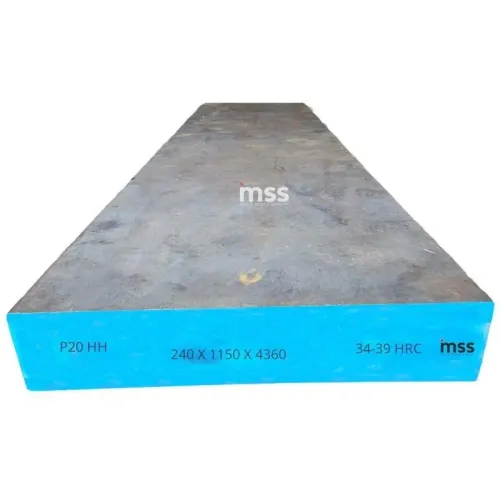
State the grade, delivery condition, and all three dimensions; “50 mm P20” is not a complete order. A complete P20 steel plate size is written as thickness × width × length, such as 50 × 1000 × 2000 mm.
1. Name the material designation: AISI P20, DIN 1.2311, or the specific mill equivalent. The search wording “din 1 point 2311 steel plate” normally refers to DIN 1.2311, not a size or product standard. Do not assume that every material sold as P20 has identical chemistry or properties.
2. State the delivery condition, such as pre-hardened, annealed, or stress-relieved. For typical 1.2311/P20, request the certified hardness range rather than relying on the grade name; supplied hardness is commonly about 28–34 HRC, depending on the mill and thickness.
3. Separate ordered dimensions from finished dimensions. Write whether 50 × 1000 × 2000 mm means mill size, saw-cut size, or ground size, and state the minimum finished dimensions after squaring, face milling, and grinding.
4. Request the dimensional tolerance, surface condition, and certificate. Specify an EN 10204 3.1 inspection certificate showing the heat number, chemical analysis, hardness, delivery condition, and measured dimensions.
Put the heat number on the plate or tag into the purchase order. A generic “P20 test certificate” without heat traceability does not prove that the delivered plate matches the stated grade.
How much machining allowance should you add to the mould plate?
Start with the mould’s finished envelope, then add stock for cutting, squaring, and surface finishing. A practical P20 steel plate size is therefore larger than the final component, not identical to it.
1. Write the finished length, width, and thickness. Separate the allowance for each operation: reserve about 3–5 mm on each sawn length and width edge for squaring, then add the material your milling or grinding plan will remove.
2. Add face allowance to the thickness. For light surface grinding, 0.5–1 mm per face is a useful starting point; increase it when the plate has scale, waviness, or heavy milling. Confirm the supplier’s saw-cut tolerance before fixing the purchase size.
3. Round the result up to an available stock dimension, but check the mould shop’s machine table, vice opening, crane, and lifting limit first. A larger plate that cannot be safely lifted is not a practical saving.
For example, a finished plate of 480 × 280 × 46 mm could become a 490 × 290 × 50 mm purchase blank when the process reserves 5 mm on each planed edge and 2 mm on each face.
State whether those dimensions are mill, saw-cut, or ground sizes; otherwise, a quoted “50 mm P20” does not guarantee 50 mm after delivery.
Request the minimum finished dimensions on the order, along with cut tolerance and the allowance retained on every face. The supplier can then propose a full plate, remnant, or cut piece without reducing your final mould size.
What P20 plate formats, prices, and delivery options are available in Gurugram?
In Gurugram, compare each quotation against the same grade, delivery condition, dimensions, cutting scope, and freight basis—not only the quoted kilogram rate. A P20 steel for plate supplier in Gurugram may quote 50 × 1000 × 2000 mm mill plate, saw-cut blanks, or ground plates; these are not equivalent purchases.
| Option | Cost and availability | Best use |
|---|---|---|
| Ready stock | Fastest dispatch; full-plate price and standard sizes | You need material quickly and can machine the excess |
| Cut piece | Adds cutting time, kerf loss, and a cut charge; confirm minimum size | Your mould needs less than a full plate |
| Remnant | Lower material cost; inspect identification, flatness, and usable dimensions | The remnant covers your blank with machining allowance |
| Ground plate | Higher price; less stock removal and inspection at your shop | Parallel faces and tighter thickness save machining time |
Ask the supplier for four separate details:
- Available stock dimensions and whether they are mill, saw-cut, or finished-ground sizes.
- Cut-to-size lead time, including cutting, packing, and dispatch.
- Minimum order, cut-piece limit, and remnant policy.
- Delivery basis: freight included or extra, GST included or extra, and delivery point in Gurugram.
Check the P20 mould steel plate price against calculated weight: length × width × thickness × 7.85 × 10⁻⁶ gives kilograms. A 1000 × 500 × 50 mm blank weighs about 196 kg before cutting loss.
Milano Special Steel, Plastic Mold Steel Expert can help separate material, cutting, and delivery charges when comparing its quotation with alternatives.
Related products
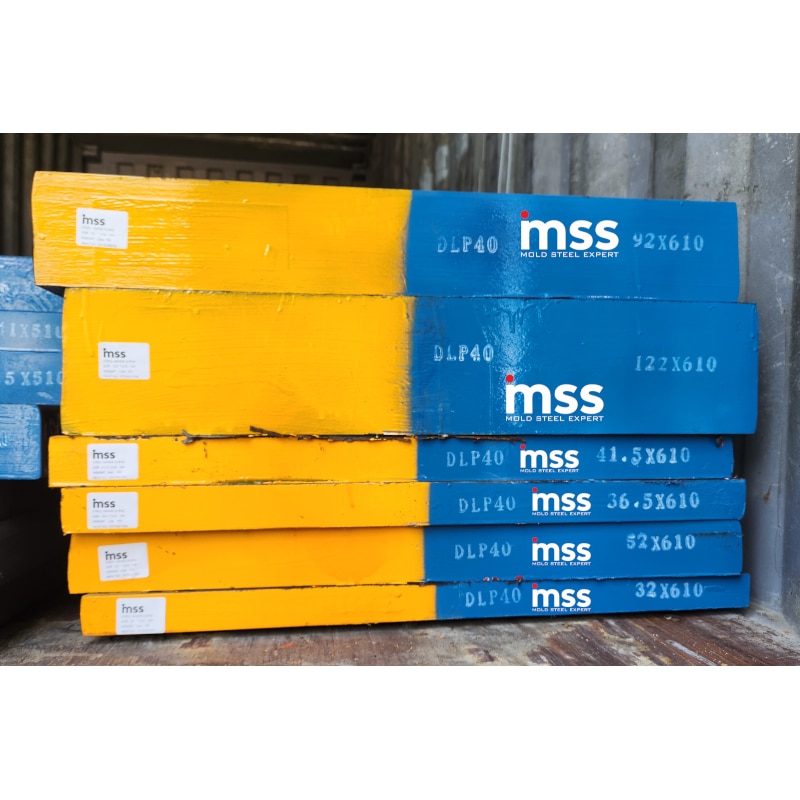 | P20 HIGH HARD STEEL 40 HRC to 44 HRC P20 High Hard steel 40 HRC to 44 HRC Yes! Milano Special Steel is a leading supplier of P20 High Hard Steel across Delhi, Gurugram, Manesar, Dharuhera, Noida, Jaipur, Faridabad, Punjab,... View product → |
 | P20 HIGH HARD STEEL P20 High Hard Steel is a popular grade of tool steel that is commonly used in the manufacturing of molds, dies, and other high-performance components... View product → |
Which P20-type grade suits your mould size and finish requirement?
A 1.2311 plate is the practical default for medium-sized injection moulds with ordinary polish, texture, and wear demands. Specify DIN 1.2311 rather than writing only P20: P20 is a family label, and chemistry, hardness, and delivery condition vary between mills.
The phrase “din 1 point 2311 steel plate” describes this grade, but the purchase order should show “DIN 1.2311” and the required hardness.
| Grade | Choose it when | Watch for |
|---|---|---|
| DIN 1.2311 | You need economical, pre-hardened steel for general mould cavities, bases, and inserts | It is not the best choice for extreme polish, thick sections, or high wear |
| P20 High Hard | The mould needs more wear resistance and arrives at a higher pre-hardness | Cutting, drilling, and EDM consume more effort; confirm the actual hardness |
| DIN 1.2738 | The mould has thick sections where more uniform through-hardness matters | Nickel-alloyed chemistry raises the importance of checking the mill certificate |
| NAK80 | You need high polishability, stable machining, fine texture, or reliable EDM performance | Compare the supplier’s certified hardness and polish guidance, not the name alone |
| P21 Improved | A premium mould requires high polish, weld-repair performance, and consistent machining | Confirm the producer’s datasheet because “P21 Improved” is not a universal chemistry |
Standard P20 is the wrong choice when a large block must retain uniform hardness, the cavity needs a mirror finish, or abrasive resin will shorten tool life. It also fails as a corrosion solution; choose a stainless mould steel when moisture or corrosive resin controls the decision.
Verify hardness, polishability, weld procedure, and EDM recommendations before substituting grades.
What certificates and acceptance checks should you require before machining?
Hold the plate for inspection until its certificate, marking, hardness, and measured size agree with the purchase order. Request an EN 10204 3.1 inspection certificate showing the stated grade, heat number, chemical analysis, delivery condition, hardness, and supplied dimensions.
Match the heat number stamped on the plate or attached tag to the certificate; a generic “P20 test certificate” without heat traceability is weak evidence.
Check these points before releasing material to machining:
| Check | Accept | Reject or clarify |
|---|---|---|
| EN 10204 3.1 certificate | Heat number, grade, chemistry, delivery condition, hardness, and dimensions are recorded | Certificate is generic, incomplete, or does not match the plate marking |
| Hardness | Recorded value falls within the ordered delivery range, verified with a portable tester if required | No hardness record, unexplained variation, or value suits another grade |
| Dimensions | Measure length, width, and thickness; check squareness and flatness against the order | Size is below the minimum after allowing for saw cutting, face milling, and grinding |
| Traceability | Tag, plate marking, packing list, and certificate carry the same heat or batch reference | Any broken link between plate and documents |
Your enquiry should name the exact grade, such as AISI P20 or DIN 1.2311, plus minimum finished dimensions, machining allowance, stock size, cut-to-size lead time, remnant policy, minimum order, and delivery basis. Check the p20 mould steel plate price against estimated weight: length × width × thickness in millimetres × 7.85 × 10⁻⁶ gives kilograms.
Frequently asked questions
How should you write a P20 steel plate size specification?
State the grade, delivery condition, and dimensions in thickness × width × length order. For example: P20, pre-hardened, 50 × 1000 × 2000 mm.
How much machining allowance should you add to a P20 mould plate?
Choose allowance according to plate size, cutting distortion, stock-removal depth, flatness, and final tolerance. Confirm the amount with your machining plan instead of adding a fixed value to every plate.
What P20 plate formats and delivery details are available in Gurugram?
Ask suppliers about standard plates, cut-to-size blocks, sawn surfaces, available thicknesses and widths, minimum order quantities, dispatch timing, transport, and the basis of the quoted P20 mould steel plate price.
Which P20-type grade suits a large mould or high-finish cavity?
DIN 1.2311 suits many general mould bases and inserts. Consider a modified or higher-uniformity grade such as 1.2738 when mould size, section uniformity, polishability, or toughness demands exceed standard P20 performance.
Which certificates and checks should you require before machining?
Request the mill test certificate with grade, heat number, chemical analysis, mechanical or hardness results, and delivery condition. Check the plate dimensions, flatness, surface defects, identification marking, and certificate-to-heat-number match.
Related products
 | P20 HIGH HARD STEEL 40 HRC to 44 HRC P20 High-Hard Steel Plates 40 HRC to 44 HRC 25MnCrNiMoV6-6-4, NIMAX, NAK80, P21 Improved View product → |
 | P20 STEEL/ DIN 1.2311 P20 STEEL PLATES is a widely used tool steel known for its high toughness, wear resistance, and machinability. View product → |
 | P20 STEEL/ DIN 1.2311 P20 STEEL DIN 1.2311 Grade P20 Steel Supplier in India - Milano Special Steel Introduction Milano Special Steel is a leading supplier of high-quality DIN... View product → |
 | P20 STEEL/ DIN 1.2311 P20 STEEL DIN 1.2311 Plastic Mould Steel Plates DIN 1.2311 Plastic Mould Steel Milano Special Steel, located in Gurugram, Haryana, near Manesar, Bawal, and Bhiwadi, is a renowned supplier of... View product → |
Keywords