A P20+Ni label does not prove that a plate is DIN 1.2738, nor does a surface hardness reading prove uniform hardness through a large mould block. By checking the heat certificate, delivery condition, section quality, stock dimensions and intended mould duty, you can decide whether 1.2738 is suitable and specify material that your machining team can accept.
Key takeaways
- Check 40CrMnNiMo8-6-4 chemistry, not only a P20+Ni description.
- Choose delivery hardness to balance machining time, wear resistance, and mould size.
- Specify plate dimensions, ultrasonic testing, hardness, and inspection documents before ordering.
- Protect machined 1.2738 surfaces from corrosion during transport and storage.
How to verify that a plate is genuinely DIN 1.2738
A genuine DIN 1.2738 plate should match the 40CrMnNiMo8-6-4 chemistry, not merely a supplier’s P20+Ni label. The nickel addition distinguishes it from DIN 1.2311/P20 and supports hardenability and toughness in thick sections.
Check the mill analysis against these typical DIN 1.2738 chemical composition ranges:
1. Carbon: 0.35–0.45%; silicon: 0.20–0.40%.
2. Manganese: 1.30–1.60%; chromium: 1.80–2.10%.
3. Nickel: 0.90–1.20%; molybdenum: 0.15–0.25%.
Treat these figures as a screening check, then confirm the exact product standard because commercial datasheets can show narrower limits.
Require a heat-specific EN 10204 3.1 certificate before acceptance. It must identify the heat number and report the chemical analysis, plate dimensions, delivery hardness, and heat-treatment condition. A generic “P20+Ni” certificate does not establish grade or traceability.
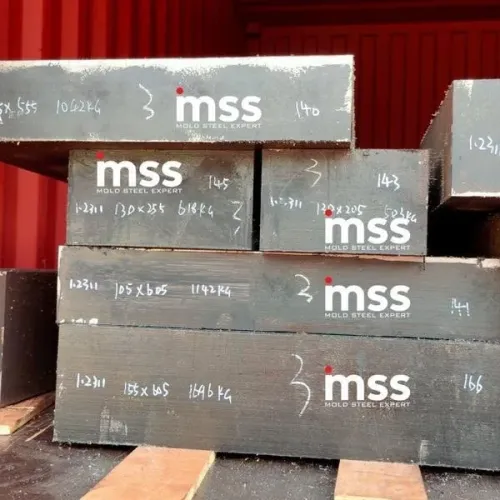
Match the certificate’s heat number to the stamped or painted marking on the parent plate. For locally cut stock, insist that every piece retains an identifiable heat reference; unmarked cut pieces create a traceability gap. Reject documentation that cannot connect the delivered plate to one specific heat.
What delivery hardness means for a large mould plate
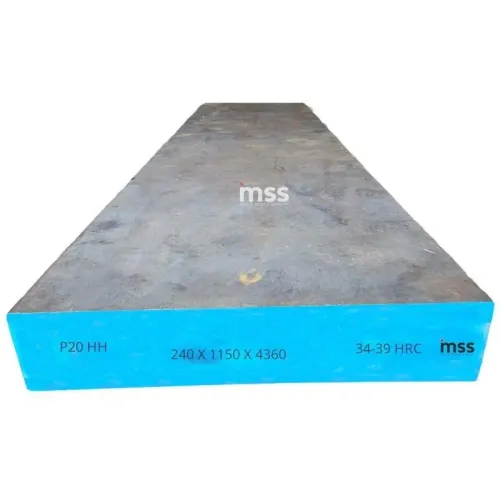
Delivery hardness is a practical acceptance point, not just a catalogue number. DIN 1.2738 hardness is normally supplied at 29–33 HRC, roughly 280–320 HB, in a quenched and tempered mould steel condition. This gives a mould plate useful strength and machinability without requiring the buyer to harden the finished block.
Heat treatment controls more than the initial cutting response. Quenching develops the required hardness through the steel, while tempering reduces brittleness and balances toughness with dimensional stability. If rough machining removes material unevenly, residual stress can release and the plate can move, leaving shut-offs or cavity surfaces out of position.
Section thickness determines whether the quoted hardness represents the working block. Nickel improves hardenability, helping a thick plate develop a stronger core than ordinary P20, but a surface hardness reading cannot prove uniformity at depth. Ask for a heat-specific EN 10204 3.1 certificate that records:
- The measured delivery hardness and heat-treatment condition
- The heat number matched to the plate marking
- The test location or sampling basis for thick material
A hardness value outside 29–33 HRC needs investigation before machining. For a large mould, leave balanced machining allowance, rough-machine both sides, allow the block to stabilise, then finish the cavity and shut-off surfaces. This sequence limits distortion that can turn an apparently acceptable plate into a costly rework job.
When 1.2738 is the right grade—and when another grade wins
Choose 1.2738 for medium-to-large injection moulds where a thick section needs reliable through-hardening and toughness. Typical DIN 1.2738 applications include automotive housings, appliance parts, structural mould bases, cavity blocks and textured or polished surfaces that do not require stainless performance.
| Grade | Best fit | Choose it when |
|---|---|---|
| DIN 1.2738 | Thick mould blocks and large cavities | Nickel-assisted hardenability matters, especially where a soft core in ordinary P20 would threaten service life |
| DIN 1.2311/P20 | Small-to-medium moulds and general-purpose tooling | Section thickness is moderate and you do not need the added toughness or through-hardening margin of 1.2738 |
| DIN 1.2316 | Corrosive moulding environments and high-gloss cavities | DIN 1.2316 corrosion resistance is more important than the lower cost and easier sourcing of conventional mould steel |
| DIN 1.2085 | Corrosive service with machining and wear demands | DIN 1.2085 wear resistance suits abrasive plastics, glass-filled materials and mould components exposed to repeated sliding |
The key decision in DIN 1.2311 versus 1.2738 is section size and core hardness, not the “P20” label. Use 1.2738 when large plates or blocks must retain consistent properties through depth; use 1.2311 when the section is smaller and the extra nickel offers no practical benefit.
For optical or mirror-polished cavities, neither nominal grade guarantees the finish. Specify vacuum-degassed, clean steel and confirm polishability history; inclusions and segregation can ruin a surface that the grade designation alone appears to support.
How to specify plate size and inspection for the Gurugram belt
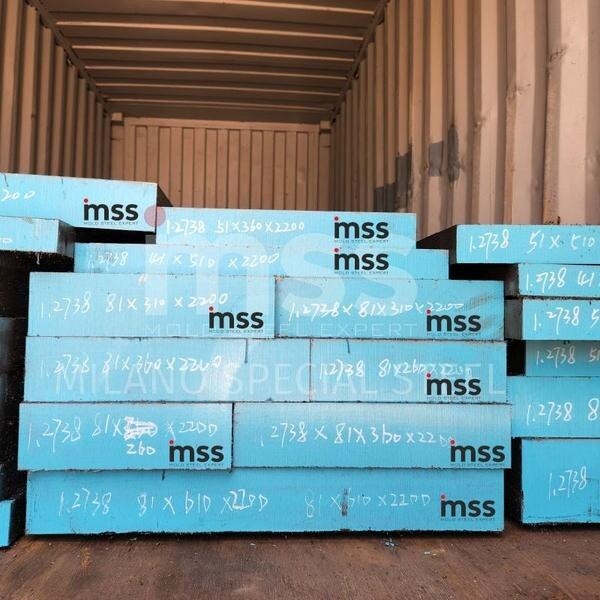
Choose the finished mould size first, then add machining allowance separately to the DIN 1.2738 plate dimensions. For cavity and core faces, allow enough material for face milling and squaring; rough-sawn stock is not guaranteed flat after cutting, even when thickness tolerances follow EN 10029.
Confirm that the required thickness fits your machining capacity and that the finished plate will retain adequate section around cooling channels, ejector holes and pockets.
- Put the required thickness, length, width, sawn oversize and maximum finished flatness on the purchase order. Do not combine flatness with the thickness tolerance.
- Request an EN 10204 3.1 certificate tied to the heat number marked on the plate, showing chemical analysis, dimensions, delivery hardness and heat-treatment condition.
- Specify EN 10160 ultrasonic testing with its inspection class and acceptance level. “Ultrasonically tested” alone does not define allowable laminations or inclusion indications.
- Ask a mould steel supplier Gurugram to confirm packing against condensation and monsoon humidity before transport to Manesar, Bawal or Bhiwadi.
| Stock form | What it means | When it applies |
|---|---|---|
| Forged block versus sawn plate | Forging improves section integrity; sawn plate offers faster sizing and lower preparation effort | Choose forged stock for thick, highly stressed mould bases; choose sawn plate when section size and ultrasonic results are adequate |
| Rough-sawn plate | Cut oversize, requiring face milling and squaring | Use when your machine shop controls the allowance |
| Precision-machined plate | Supplied closer to finished dimensions and flatness | Use when setup time or milling capacity is limited |
Milano Special Steel, Plastic Mold Steel Expert can help match the requested stock form to the machining route rather than treating every plate as interchangeable.
Machining, polishing, welding and storage requirements
Treat the plate as prehardened tool steel, not stainless steel. Before machining DIN 1.2738, record thickness, flatness and machining allowance separately; EN 10029-type thickness tolerances do not guarantee a mould-ready face. Rough-sawn stock needs balanced face milling, and large blocks need stress relaxation before final cavities or shut-offs.
1. Protect both faces with rust-preventive oil, dry wrapping and covered storage. Keep the plate off concrete and away from condensation, fingerprints, cooling-water leaks and humid monsoon air in Gurugram.
2. Rough-machine symmetrically, removing similar amounts from opposite faces. Leave a balanced finishing allowance, inspect for distortion after roughing, then stabilise the block before finish machining.
3. Control cutting heat and tool condition. A blunt tool or aggressive feed can distort the surface and create rework before polishing.
4. Treat tool-steel repair welding as a qualified operation. Use preheating, low-hydrogen consumables, controlled interpass temperature, slow cooling and a suitable post-weld temper or stress-relief cycle. An uncontrolled repair leaves a cracked or hard heat-affected zone that machines and textures differently.
5. Clean every polishing stage thoroughly and prevent coarse abrasive carryover. DIN 1.2738 polishability depends on cleanliness, segregation and prior processing, not the grade name alone; request high-cleanliness material and a representative polishability sample for optical cavities.
After final machining, seal exposed surfaces again and store the finished mould dry. Rust prevention for mould steel continues through transport, assembly and any shutdown period.
Frequently asked questions
How can you verify that a plate is genuinely DIN 1.2738?
Check the material test certificate for the 40CrMnNiMo8-6-4 designation, chemical analysis, heat number, delivery hardness, and traceability to the plate. Do not rely on a P20+Ni label alone.
What does delivery hardness mean for a large mould plate?
Delivery hardness is the hardness measured when the steel leaves the supplier. It affects machining effort, wear resistance, dimensional stability, and the need for later heat treatment, so compare the stated HRC or HB range with your mould design.
When is DIN 1.2738 the right mould steel?
Choose 1.2738 for large mould bases, inserts, and mould components that need nickel-assisted toughness and hardenability through thick sections. Select another grade when corrosion resistance, mirror polishing, higher wear resistance, or simpler machining is the primary requirement.
What should you specify when ordering a mould plate in the Gurugram belt?
State finished and rough dimensions, thickness tolerance, flatness, squareness, delivery hardness, ultrasonic testing requirements, heat-number marking, and the inspection documents required with delivery.
How should you machine, polish, weld, and store 1.2738 steel?
Use rigid workholding and controlled cutting parameters, remove the altered surface before polishing, follow a qualified preheat and post-weld procedure, and apply corrosion protection after cleaning and during covered, dry storage.