Choosing DIN 1.2085 for a plastic mould requires more than confirming its stainless tool-steel designation. You need to match its sulfur-alloyed composition, pre-hardened delivery condition and polishing limits with the mould component, plastic grade, production volume and inspection documents before ordering stock.
Key takeaways
- Use DIN 1.2085 for corrosion-resistant inserts, plates and compact moulds.
- Avoid it when the mould requires a mirror-polished optical cavity.
- Plan machining around its pre-hardened 280–325 HB condition.
- Specify hardness, dimensions, surface condition and inspection documents when ordering.
Which plastic mould components suit DIN 1.2085 in Gurugram production?
The most practical DIN 1.2085 applications are mould parts that need useful corrosion resistance and straightforward machining, but not a mirror-polished optical surface. Its pre-hardened delivery condition, commonly about 280–325 HB, suits Gurugram toolrooms producing inserts, plates and compact moulds without adding a hardening cycle and its distortion risk.
| Component | Practical fit | Check before use |
|---|---|---|
| Cavity inserts | Suitable for general injection cavities exposed to moisture or chemically aggressive plastics | Avoid high-gloss optical or lens surfaces unless the polishing requirement is confirmed |
| Core inserts | Useful for non-optical cores in PVC and other corrosive-material moulds | Assess the core surface, cooling channels and expected maintenance interval separately |
| Slides | Suitable for corrosion-prone sliding details and replaceable side actions | Provide adequate lubrication and verify wear demands |
| Lifters | Practical for moderate-duty ejecting and forming features | Check contact stress, alignment and abrasive filler content |
| Holders | A strong choice for insert holders exposed to damp production conditions | Do not assume the grade protects dissimilar inserts or pins |
| Backing plates | Suitable where pre-hardening simplifies machining and avoids quench distortion | Allow for movement after heavy rough machining |
| Small production moulds | Fits short-run or moderate-volume tools needing economical corrosion resistance | Reconsider it for very high shot counts or severe abrasive service |
For a Gurugram production environment, keep stock and finished moulds dry because condensation, chloride-bearing water and acidic residues can still stain or pit 1.2085. Use it as part of a corrosion-control plan, not as a substitute for protected cooling passages, ejector components and mould exteriors.
How does pre-hardened DIN 1.2085 change machining and finishing?
The DIN 1.2085 hardness of roughly 280–325 HB allows you to machine many mould plates, backing components and inserts in the delivery condition. This pre-hardened mould steel avoids a later hardening cycle, reducing quench distortion, but it is not soft steel: use rigid workholding, sharp carbide tools and controlled cutting parameters.
Plan the process around these effects:
- Rough machining can release residual stress. Leave finishing allowance on large blocks, then stabilise or stress-relieve them where the procedure specifies it.
- After the block settles, take the final finishing passes. This protects cavity dimensions and parting-line alignment.
- Drilling and tapping need rigid setups, suitable carbide or high-performance drills, controlled feed, and careful chip evacuation. Excessive force can break taps or distort small holes.
- EDM removes material without cutting force, but the recast layer and heat-affected zone need removal when the surface will be polished or subjected to fatigue loading.
- Polishing is practical after correct EDM cleanup and progressively finer abrasive work. Sulfur-assisted machinability does not guarantee the mirror finish associated with lower-sulfur grades.
- Repair welding is not routine carbon-steel work. Use a qualified procedure covering preheat, filler selection, interpass control, slow cooling and any required tempering; otherwise cracking, soft zones and polish lines can appear.
How should you compare DIN 1.2085 with other mould steels?
Compare the steel against the failure you need to prevent, not against chromium content alone. DIN 1.2085 is X33CrS16, with approximately 0.33% carbon, 16% chromium and sulfur for improved machinability; that sulfur also raises inclusion and polishing risks.
| Grade | Main advantage | Choose it when |
|---|---|---|
| DIN 1.2085 | Corrosion resistance with easier machining | You need pre-hardened components, holders or non-optical inserts and mirror polishing is not the priority |
| DIN 1.2083 | Cleaner polish and fine surface finish | The DIN 1.2083 comparison points to lens moulds, high-gloss cavities and demanding etched textures |
| DIN 1.2316 | Strong corrosion resistance with better toughness | PVC, flame-retardant or moisture-sensitive plastics attack the mould, especially where toughness matters |
| DIN 1.2311 | Pre-hardened, economical general-purpose tooling | The mould uses non-corrosive resin and needs robust machining rather than stainless protection |
| DIN 1.2738 | Tough, large-section pre-hardened steel | A large mould, thick block or heavily loaded component needs through-section toughness and dimensional stability |
Use a 1.2316 comparison when corrosive resin, condensate or cooling-water exposure threatens cavities, cores, pins or passages. Choosing 1.2085 only for the mould base does not protect uncoated ejector components or water-side surfaces.
For glass-filled or mineral-filled plastics, abrasive wear can outweigh corrosion resistance; select the grade and hardness that protect the gate, shutoff and runner surfaces. Choose 1.2083 for critical mirror polish, because sulfide inclusions in 1.2085 can show during fine polishing or etching.
Confirm the grade before substitution: a low-sulfur steel changes cutting parameters, delivery hardness and cost.
How do plastic, mould design and maintenance determine suitability?
Choose 1.2085 for PVC moulding and other corrosive formulations when corrosion resistance matters more than mirror polishing. Acidic residues, chloride-bearing water and aggressive release agents can still stain or pit the steel, so the resin and cleaning process must be reviewed together.
Glass-filled plastics increase abrasive wear on gates, cavities, cores and ejector pins. A low shot count and a small mould may justify 1.2085, while a high-volume tool needs a wear and maintenance plan, especially where thin walls, sharp shut-offs or textured surfaces concentrate damage.
Mould size also affects suitability. Large or thick blocks require internal-soundness checks, not only a hard surface; ultrasonic testing can reveal laminations that machining will not expose. Design cooling channels for complete drainage, because stagnant water can corrode the channels and spread rust into an otherwise protected tool.
Assess each exposure zone separately:
- Cavity and core: corrosion, polishing and texture requirements
- Ejector pins and slides: wear, staining and clearance loss
- Cooling channels: water quality, deposits and stagnant moisture
- Mould exterior: condensation, handling damage and storage corrosion
Set mould maintenance around the shot count, resin, cooling-water condition and expected service interval. Clean PVC residue promptly, inspect pins and vents, dry the tool after production, and apply compatible rust preventive during storage. For high-gloss optical cavities or demanding textures, select a low-inclusion polishing grade instead.
What should you specify when ordering DIN 1.2085 stock in the Gurugram-Manesar supply chain?
A purchase order should identify X33CrS16 by material number DIN 1.2085, not by the vague term “stainless mould steel.” That distinction prevents substitution with DIN 1.2083, DIN 1.2316 or another grade with different machining and polishing behaviour.
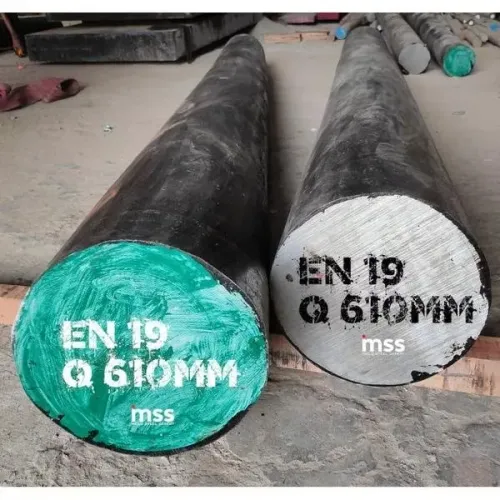
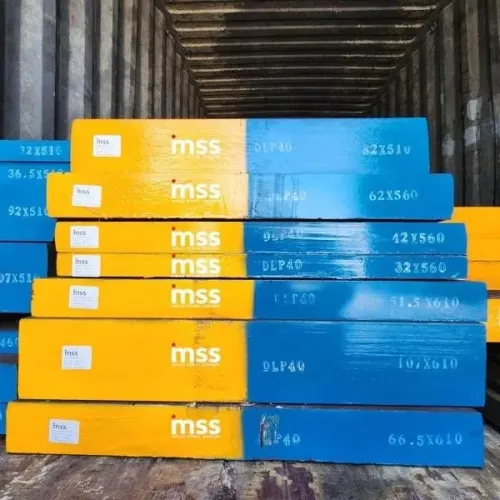
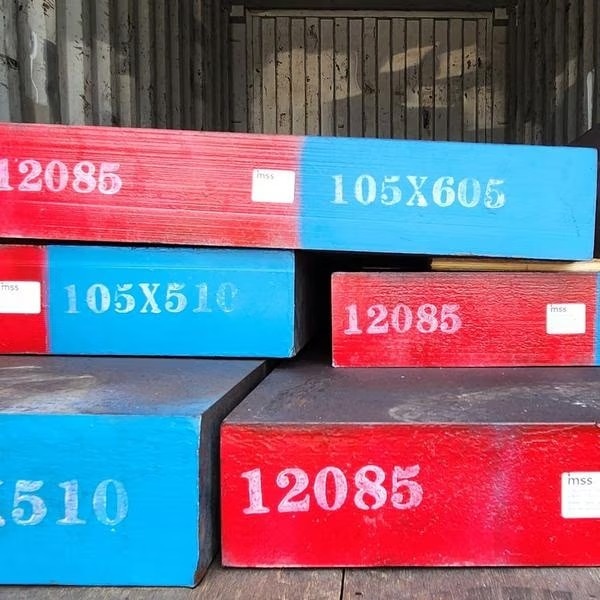
- State the product form: DIN 1.2085 plate, DIN 1.2085 block or DIN 1.2085 round bar.
- Give finished dimensions and the required machining allowance on every face. Large blocks need roughing stock because material removal can release residual stress.
- Specify delivery hardness, such as the pre-hardened 280–325 HB range, rather than accepting an unspecified condition.
- Request heat-treatment records showing the treatment applied and the resulting hardness.
- Require a mill test certificate listing the material number, chemical analysis, delivery hardness, dimensional condition and heat number.
- Ask the supplier to mark or trace the heat number on each bundle, plate, block or bar.
- Define dimensional condition: sawn, forged, peeled, ground or machined, with tolerances stated against the ordered size.
- Add ultrasonic testing for thick blocks, heavy plates or critical mould sections, with the test standard and acceptance level written into the purchase order.
Use these same fields when comparing Gurugram-Manesar quotations, including one from Milano Special Steel, Plastic Mold Steel Expert. Reject stock that has only a grade name and surface inspection when internal soundness matters.
Related product
 | DIN 1.2085 STEEL DIN 1.2085 steel is a corrosion-resistant, pre-hardened plastic mold steel with excellent wear resistance. View product → |
Frequently asked questions
Which plastic mould components suit DIN 1.2085 in Gurugram production?
DIN 1.2085 suits inserts, plates and compact mould components needing useful corrosion resistance and straightforward machining. Choose another grade for mirror-polished optical surfaces or demanding wear conditions.
How does pre-hardened DIN 1.2085 change machining and finishing?
The commonly supplied 280–325 HB condition removes a separate hardening cycle and reduces distortion risk. Use rigid setups, suitable carbide tooling and a finishing allowance matched to the required surface quality.
How should you compare DIN 1.2085 with other mould steels?
Compare corrosion resistance, hardness, polishability, wear resistance, machinability, heat-treatment requirements and total lead time against grades such as P20, 1.2316 and 1.2083.
How do plastic, mould design and maintenance determine suitability?
Match the steel to the plastic’s corrosiveness, filler content and processing conditions, then check wall thickness, cooling layout, ejection loads and cleaning practices. These factors determine whether corrosion resistance and hardness are sufficient.
What should you specify when ordering DIN 1.2085 stock in the Gurugram-Manesar supply chain?
State the grade, plate or round-bar form, finished dimensions, delivery hardness, surface condition, quantity, straightness or flatness tolerance, heat number and inspection documents.